Wholesale Gorilla works fine until it doesn’t—and for most growing B2B operations, that moment arrives when price lists multiply, ERP sync becomes non-negotiable, or wholesale buyers start expecting net terms and quote workflows that the app can’t deliver.
The right alternative depends on whether you want to stay on Shopify with a more capable app or move to a standalone B2B platform entirely. This guide breaks down the top Wholesale Gorilla alternatives, compares their features and pricing, and walks through how to evaluate which one fits your operation.
What Is Wholesale Gorilla and How It Works on Shopify
Wholesale Gorilla is a Shopify app that adds wholesale pricing and order forms to your existing store. You tag customers, assign them to discount groups, and control which products each group sees. It handles percentage discounts and simple order forms without a separate wholesale site, which covers the basics for merchants starting out in wholesale.
The right alternative depends on one question: do you want to stay on Shopify with a more capable app, or move to a standalone B2B platform? Most merchants who scale stay on Shopify and switch to a dedicated B2B app, keeping their store and theme while adding wholesale capabilities that grow with the operation. The question becomes whether Wholesale Gorilla’s fundamentals hold up as your B2B volume climbs.

Why Shopify Merchants Look for a Wholesale Gorilla Alternative
Merchants typically start searching for alternatives when their wholesale operations outgrow what basic discount tiers can handle. The triggers vary, but a few patterns come up again and again.
- Price list complexity: Managing dozens of customer-specific price lists in a system built for simple percentage discounts becomes a full-time job
- Disconnected systems: When your ERP holds the source of truth for pricing and inventory, but your Shopify app can’t sync with it, you’re entering data twice
- Missing B2B checkout features: Wholesale buyers expect net 30 or net 60 payment terms, credit limits, and quote-to-order workflows—not a consumer checkout
- Operational overhead: If your team spends hours each week reconciling orders or manually updating prices, the app has become a bottleneck
The underlying issue is usually the same: you’ve built a wholesale business that operates like an enterprise, but your tools still operate like a startup.
Signs You Have Outgrown Wholesale Gorilla
Disconnected ERP and CRM Data
When pricing, customers, and orders don’t sync automatically between Shopify and your ERP, your team ends up entering the same information in multiple places. This creates reconciliation errors, delays order processing, and makes it harder to trust your numbers.
If you’re running NetSuite, Zoho, Odoo, or a custom ERP, the lack of native integration means manual work that compounds as you scale.
Manual Price Lists and Limited Pricing Rules
Tiered pricing, contract pricing, and per-customer price lists require more than percentage discounts. Without automation or bulk import tools, updating prices across hundreds of SKUs and dozens of customer groups becomes a bottleneck.
You might recognize this if your team dreads price changes or if pricing errors show up in customer complaints.
Weak B2B Checkout and Net Terms Workflows
Wholesale buyers expect a checkout experience built for how they actually purchase. That means a dedicated B2B cart, net payment terms, and credit limit controls—not a consumer checkout with a discount code applied.
No Native Quote to Order or RFQ Process
For larger orders, buyers often want to request a quote before committing. Without RFQ functionality built into your platform, you’re handling quotes through email and manually creating orders afterward. This slows deal cycles and introduces errors.
Scaling Hybrid B2B and B2C on One Storefront
Running separate stores for B2B and B2C doubles your operational work. A unified storefront with role-based visibility lets you serve both audiences from one Shopify store, but that requires access controls that basic wholesale apps don’t provide.
How to Evaluate a Wholesale Gorilla Alternative for Shopify
Advanced B2B Pricing Engine
Look for platforms that support role-based pricing, contract price lists, volume rules, minimum and maximum quantities, case packs, multi-currency, and tax-exempt logic. Granular pricing control lets you reward larger purchases automatically and serve different customer segments without manual intervention.
Deep ERP and CRM Integration
Native connectors to NetSuite, Zoho, and Odoo matter, along with enterprise APIs for custom ERPs. Bi-directional sync of customers, orders, and inventory keeps your systems aligned without your team copying data between platforms.
B2B UX Built for Wholesale Buyers
Quick order forms, CSV upload, saved carts, reorders, a dedicated B2B cart with net terms, and embedded registration all contribute to faster ordering. The buying experience directly affects whether wholesale customers come back or find a competitor with a smoother process.
Unified B2B and B2C Storefront
Running both channels on one Shopify store reduces operational cost, maintains a single inventory source, and keeps branding consistent. You avoid the overhead of managing two separate sites while still controlling what each customer segment sees.
Implementation and Ongoing Support
Self-serve apps work for simple setups. Complex B2B operations benefit from hands-on onboarding, customization, and technical partnership after launch—especially when you’re integrating with existing systems.
Best Wholesale Gorilla Alternatives for Shopify B2B
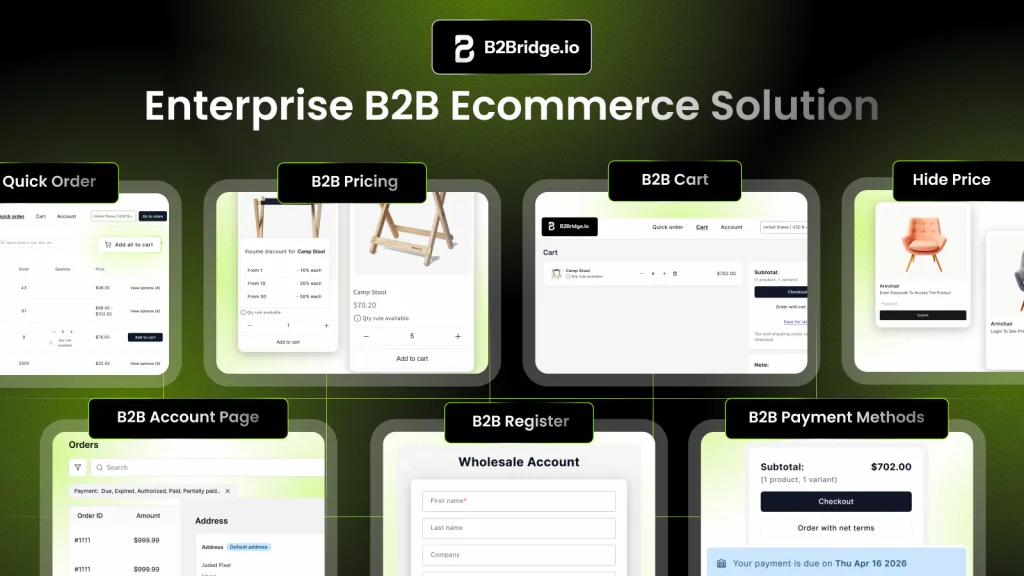
B2Bridge
Best for: Manufacturers, distributors, and hybrid brands scaling wholesale on Shopify who need complex pricing, a sales team workflow, and ERP sync
B2Bridge keeps price lists, orders, and customer groups unlimited at a flat monthly price, so your bill stays the same as your wholesale volume grows. That is the core difference from Wholesale Gorilla and from most Shopify B2B apps, which cap catalogs or charge by order tier once you scale.
It runs the whole wholesale workflow in one app instead of stitching several together: an advanced pricing engine with contract pricing, volume rules, and per-customer price lists; net payment terms; quote-to-order and RFQ; and a unified B2B and B2C storefront on standard Shopify plans. A Sales Rep Portal lets your team place orders on behalf of customers and track commission, which neither Shopify native nor most competitors offer. Deep integrations with NetSuite, Zoho, and Odoo keep pricing, customers, and orders in sync, and hands-on implementation support sets the account up around your real workflows.
Standout features: Unlimited price lists, orders, and customer groups; Sales Rep Portal; NetSuite, Zoho, and Odoo sync; quote-to-order and RFQ; net terms
Considerations: Built for merchants with real B2B complexity; a simple discount-tier setup may not need this depth
Pricing: Free plan available; paid plans from $99/month (unlimited unlocks at $99)
SparkLayer
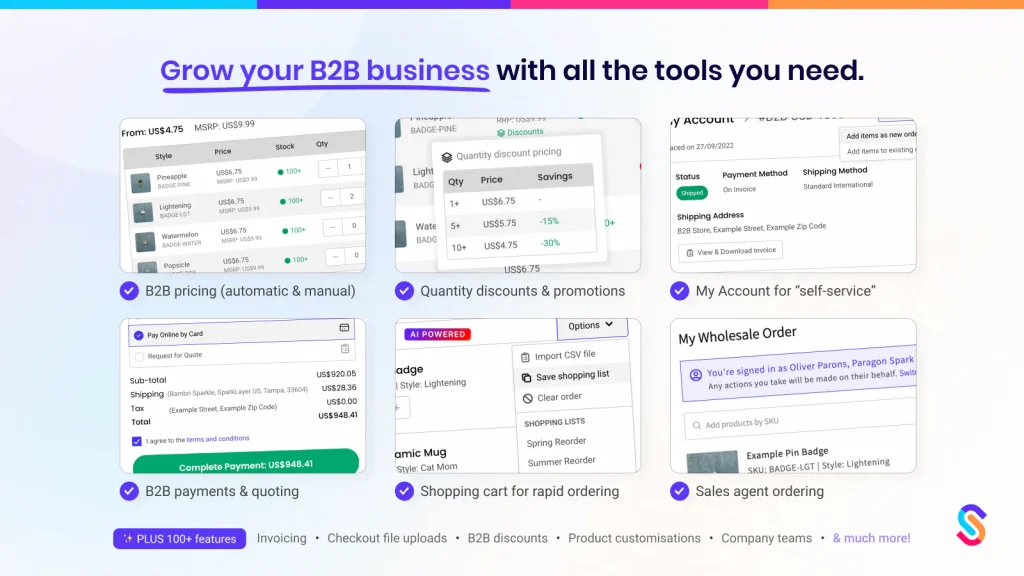
Best for: Scaling brands that want strong theme integration and sales agent tools
SparkLayer offers native price list management, sales agent functionality, and net payment terms from lower tiers. It integrates well with existing Shopify themes and provides a free tier for merchants just getting started.
Pricing: Starts at $49/month.
Limitation: ERP integration depth may require additional development for complex sync requirements.
Wholesale Club
Best for: Early-stage wholesale with straightforward bulk discount tiers
Wholesale Club helps increase average order value through tiered discounts. It’s simpler than enterprise alternatives and offers strong customer support for merchants learning wholesale operations.
Limitation: Lacks advanced features like quote-to-order, net terms, or ERP integration.

Shopify B2B Native
Best for: Merchants who want built-in B2B features and only run a handful of price lists
Shopify’s native B2B is now free on Basic, Grow, and Advanced plans, so company accounts, catalogs, volume pricing, and net terms no longer require a Plus upgrade. For a small wholesale setup it covers the essentials without a third-party app.
Considerations: Non-Plus plans cap you at 3 active catalogs, and there is no Sales Rep Portal and no built-in ERP sync. Merchants running many price lists or syncing with an ERP outgrow it quickly. Full native B2B with unlimited catalogs still sits on Shopify Plus, which starts around $2,300/month as of 2026.

BSS B2B Solution
Best for: Merchants who want proven, review-backed wholesale features and are comfortable running more than one app
BSS B2B Solution delivers wholesale pricing, lock and login, and quote workflows across a suite of apps with a large App Store review base. It covers core B2B needs on standard Shopify plans.
Considerations: Features are split across separate apps rather than one system, so you manage several installs and watch for conflicts. There is no Sales Rep Portal.
Wholesale Gorilla Alternatives Feature Comparison
| Feature | B2Bridge | SparkLayer | Wholesale Club | Shopify B2B Native |
|---|---|---|---|---|
| Unlimited price lists, orders, customer groups | ✓ | Order-tier limits | Limited | 3-catalog cap (non-Plus) |
| Sales Rep Portal | ✓ | Sales agent tools | ✗ | ✗ |
| Contract pricing | ✓ | ✓ | Limited | ✓ |
| ERP sync (NetSuite, Zoho, Odoo) | ✓ | Partial | ✗ | ✗ |
| Quote-to-order and RFQ | ✓ | ✓ | ✗ | ✗ |
| Net payment terms | ✓ | ✓ | ✗ | ✓ |
| Quick order forms | ✓ | ✓ | ✗ | ✓ |
| Shopify Plus required | ✗ | ✗ | ✗ | ✗ (free on all plans) |
How to Choose the Right Wholesale Gorilla Alternative
Your choice depends on where you are operationally and where you’re headed.
- Early-stage wholesale: Simpler apps like Wholesale Club work if you only require basic discount tiers
- Scaling B2B with complex pricing: SparkLayer or B2Bridge if you require contract pricing, volume rules, and net terms
- Enterprise with ERP requirements: B2Bridge if you require deep NetSuite, Zoho, or Odoo sync and hands-on implementation
- Considering leaving Shopify: Standalone platforms if you want to bypass Shopify entirely
Outcome: Match operational complexity to solution depth so you don’t overpay for features you don’t use—or underbuy and hit limitations within months.
How to Migrate From Wholesale Gorilla to a New B2B Platform
Step 1: Audit your current B2B workflows and data
Document existing customer groups, price lists, discount rules, and order workflows. Identify what’s working and what’s manual or broken. This audit becomes your migration checklist.
Step 2: Map pricing rules, customer groups, and ERP fields
Create a mapping document that translates Wholesale Gorilla’s structure into the new platform’s fields. Ensure ERP and CRM data alignment before migration to avoid importing mismatched records.
Step 3: Pilot the new platform with a test customer segment
Run a small group of wholesale customers on the new system. Validate pricing, checkout, and order sync before full rollout. This catches issues before they affect your entire customer base.
Step 4: Migrate customers, price lists, and open orders
Use CSV import or API to transfer data. Verify that customer-specific pricing and order history remain intact after the move.
Step 5: Launch and monitor performance post-switch
Go live with the full customer base. Track order accuracy, sync errors, and wholesale conversion rate, then adjust workflows as needed.
Frequently Asked Questions About Wholesale Gorilla Alternatives
What is the difference between Wholesale Gorilla and SparkLayer?
SparkLayer offers deeper theme integration, native price list management, and advanced features like sales agent tools and net payment terms from lower tiers. Wholesale Gorilla places many B2B features on higher-cost plans.
How much does Wholesale Gorilla cost?
Wholesale Gorilla pricing starts around $34.95/month (as of 2026; verify on the Shopify App Store), with advanced features like custom pricing and order forms typically requiring higher-tier plans. Check the Shopify App Store for current pricing.
Can you run advanced B2B on Shopify without Shopify Plus?
Yes. Apps like B2Bridge and SparkLayer deliver enterprise B2B features—contract pricing, net terms, quote-to-order—on standard Shopify plans without requiring a Plus upgrade.
Does Wholesale Gorilla integrate with NetSuite or other ERPs?
Wholesale Gorilla has limited native ERP integration. Merchants requiring deep sync with NetSuite, Zoho, or Odoo typically choose a more integration-focused alternative.
Scaling B2B on Shopify Beyond Wholesale Gorilla
When your wholesale volume outgrows Wholesale Gorilla, the app that fits is the one that does not charge you more for growing. B2Bridge keeps price lists, orders, and customer groups unlimited at a flat price, and runs pricing, net terms, quotes, the Sales Rep Portal, and ERP sync in one app on standard Shopify plans.
The platform adapts to your pricing models, ERP requirements, and workflows instead of a fixed template, so you scale wholesale without splitting work across tools or upgrading your Shopify plan.
Book A Demo to see how B2Bridge handles your pricing models, ERP sync, and wholesale workflows.

As a Product Marketing Executive at B2Bridge, I focus on the Enterprise B2B Ecommerce domain. I leverage my understanding of product and user psychology to deliver customer-centric content that addresses business challenges and fuels growth.