Shopify is both B2B and B2C. Shopify the company is a B2B software business that sells subscriptions and payment services to merchants. Shopify the platform lets those merchants sell to consumers, to other businesses, or to both from one store. Since April 2, 2026, native B2B features run on every paid plan, from Basic to Plus.
If you run a retail store and wholesale enquiries keep landing in your inbox, the question you’re facing is whether your current plan can serve trade buyers without a rebuild. This guide covers what native Shopify B2B includes, where it stops, and how to pick a setup that fits your wholesale channel.
Is Shopify B2B or B2C?
Shopify is a B2B company that powers both B2B and B2C stores. The confusion comes from one word covering three different things, and each has its own answer.
| When people say “Shopify” | What it is | B2B or B2C? |
|---|---|---|
| Shopify the company | A commerce software provider whose customers are merchants | B2B |
| The Shopify platform | The admin, storefront and checkout merchants run their stores on | Both, depending on the merchant |
| Shopify B2B | Native wholesale features inside the Shopify admin | B2B |
Most merchants asking this question want the second answer. Your store is B2C by default, and it becomes B2B when you set up companies and catalogs for business buyers. Shopify’s Help Center confirms you can run B2B and direct-to-consumer sales from one store, or open a separate B2B-only store. For the operational differences between the two models, see our guide to B2B vs B2C ecommerce.
Why Shopify itself is a B2B company
Shopify is a B2B company because every paying customer is a business. Its customers are merchants, who pay for software subscriptions and payment processing.
Shopify reports revenue in two segments. Subscription solutions is mainly plan fees, and merchant solutions is mainly payments. Merchants pay for both. A shopper buying sneakers on a Shopify store is the merchant’s customer. Shopify doesn’t sell to that shopper, and it only sees the sale as payment volume.
B2B sales by Shopify merchants grew 130% year over year in Q1 2024, according to Shopify’s newsroom. That growth explains why Shopify kept adding wholesale features to its core admin. When you read “Shopify B2B,” it refers to those features for your business buyers. It doesn’t describe how Shopify itself earns money.
How Shopify supports B2C selling
B2C is Shopify’s default mode. A new store has one public catalog, one price per variant, and a checkout built for cards and digital wallets. Shoppers check out as guests or with an individual account.
Standard plans are tuned for this flow, from themes and discount codes to Shop Pay, abandoned checkout emails and the app ecosystem. Basic starts at $29 per month billed yearly, or $39 billed monthly, per Shopify’s pricing page.
The B2C setup strains once a trade buyer asks for a different price. Discount codes and customer tags can cover the gap for a while. They break down when you need payment terms, minimum quantities, purchase order numbers or a price list per account. That’s the job native B2B was built for.
What changes when the second buyer on your store is a business?
What native Shopify B2B includes on every plan
Shopify B2B is the set of wholesale features built into the Shopify admin. Since April 2, 2026, it runs on Basic, Grow, Advanced and Plus. Most features are identical across plans, and the differences come down to catalog limits plus a few payment and storefront options. Shopify Flow also works with B2B objects on every plan, so you can automate tasks like payment reminders.
| Feature | Basic | Grow | Advanced | Plus |
|---|---|---|---|---|
| Companies and company locations | Yes | Yes | Yes | Yes |
| Active B2B catalogs | 3 | 3 | 3 | Unlimited |
| Catalogs assigned directly to a company | No | No | No | Yes |
| Quantity rules and price breaks | Yes | Yes | Yes | Yes |
| Net terms, vaulted cards, ACH (US) | Yes | Yes | Yes | Yes |
| PO numbers and quick order list | Yes | Yes | Yes | Yes |
| Contextual storefront and checkout | No | No | Yes | Yes |
| Deposits and partial payments | No | No | No | Yes |
Source: Shopify B2B features by plan, Shopify Help Center, checked October 2026.
A buyer becomes B2B when you add them as a contact at a company location, the record that holds their catalog, payment terms, tax settings and address. On non-Plus plans, catalogs are assigned through B2B markets, which requires the new Shopify Markets. Plus starts from $2,300 per month, and our Shopify B2B vs Shopify Plus comparison breaks down when that upgrade pays off.
Where native Shopify B2B stops
Native B2B handles a simple wholesale channel well and runs out at four points. Each one appears as your buyer count and pricing rules grow.
The three-catalog cap
Basic, Grow and Advanced allow 3 active catalogs across all B2B markets combined. Assigning three to one market uses the whole allowance. If you’re pricing distributors, retailers, salons and one key account differently, you’ve already hit the limit.
No customer-level catalogs below Plus
Basic, Grow and Advanced can’t assign a catalog directly to a company or company location. Only Plus can. On other plans, buyers inherit pricing from their B2B market. Negotiated per-account pricing needs Plus or an app with its own price lists.
No quote negotiation or buyer-facing rep portal
Checkout to draft lets a buyer send a cart for your review. There’s no dedicated quote workflow with counteroffers. Sales staff permissions work inside the admin, while reps who order for buyers from a portal need an app.
Deposits and partial payments are Plus-only
Net payment terms work on every plan. Deposit requirements, partial payments and payment requests per fulfillment are Plus-only. That matters for made-to-order goods and large first orders. If you need a deposit before production starts, you’ll collect it outside Shopify checkout or move to Plus.
>> See more: Shopify B2B and Wholesale Limitations
Blended store vs dedicated B2B store
A blended store serves retail shoppers and B2B buyers from one storefront and admin, with shared inventory. A dedicated B2B store is a separate Shopify store just for business buyers. Shopify supports both.
| Decision point | Blended store | Dedicated B2B store |
|---|---|---|
| Admin and inventory | One, shared by both channels | Separate |
| Storefront access | Public retail, B2B prices after login | Can be fully gated |
| Branding | Shared theme with B2B content by context | Independent |
| Best for | Brands selling the same range to both groups | Wholesale with distinct stock, staff or branding |
Most hybrid brands start blended. There’s one catalog to maintain and one place to see orders. Payment methods and shipping rates are shared by default, so you’ll configure buyer-specific rules before launch. Inventory is shared too, and Shopify doesn’t reserve stock by customer type unless you build that process yourself. Our guide to running B2B and B2C in one store walks through that setup step by step, and the blended vs dedicated store comparison covers the decision in depth.
How to choose your Shopify setup for B2B and B2C
Which setup fits your store? Match it to how you sell wholesale today and what you expect in 12 months.
| Your situation | Setup to start with |
|---|---|
| A few trade buyers, up to 3 price tiers, standard net terms | Native B2B on your current plan |
| More than 3 price tiers or per-account pricing | Native B2B plus a B2B app, or Shopify Plus |
| Quotes, a sales rep portal or ERP sync | A B2B app that includes those workflows |
| Deposits, checkout customization and high order volume | Shopify Plus |
| Separate stock, staff or brand for wholesale | Dedicated B2B store |
Weight scale heavily. If you’ll pass three pricing tiers soon or rely on reps placing orders, an all-in-one app with unlimited price lists avoids stacking several single-purpose tools. Our roundup of Shopify B2B apps compares B2Bridge with the main alternatives.
Revisit the choice whenever your wholesale channel changes shape. A new distributor tier or an ERP project usually moves you down a row in the table. It’s cheaper to plan that move early than to rebuild price lists in the middle of a busy season.
Run retail and wholesale from one store with B2Bridge
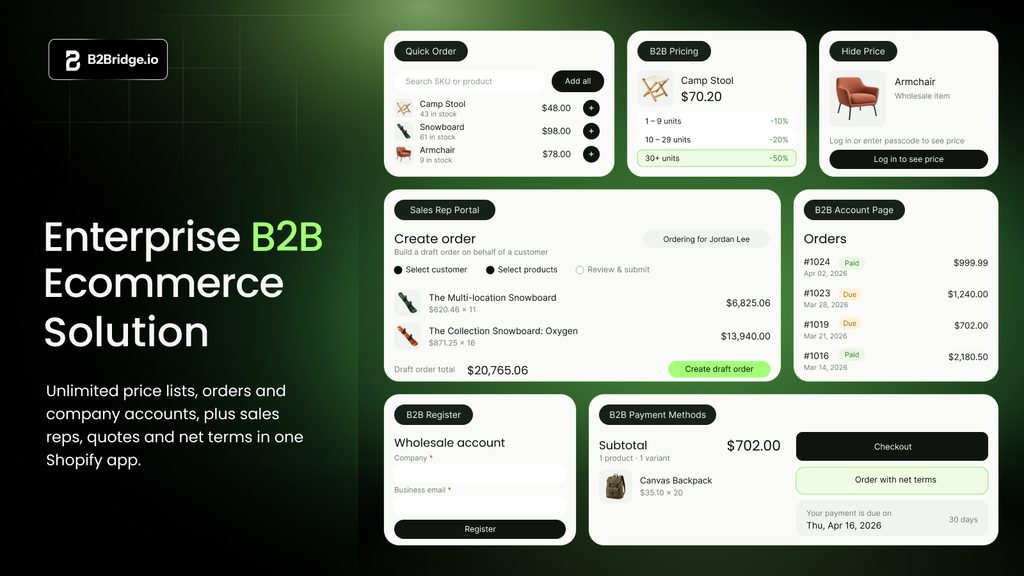
B2Bridge adds the wholesale layer inside your existing Shopify admin when native B2B runs short. Retail shoppers keep the normal storefront, and verified buyers get their own prices and ordering experience after login. More than 500 Shopify merchants use it today.
- Unlimited B2B price lists, customer groups and B2B orders
- Wholesale pricing, net terms, quote requests, quick ordering and a buyer portal in one app
- Sales Rep Portal, request for quote, credit limits and company accounts on Growth ($199/month)
- ERP sync with NetSuite, Zoho or Odoo, with a Public API on Advanced ($299/month)
Plans start at $99/month for Professional after a 14-day free trial, and Enterprise pricing is custom. See full plan details. Bring a sample of your buyer groups and price rules, and we’ll show you how they’d run on your store.
FAQs about Shopify B2B and B2C
Is Shopify good for B2B?
Yes, it’s a strong fit for most small and mid-size wholesale channels. Native B2B covers companies, catalogs, net terms and quantity rules on every paid plan. Stores needing more than three price tiers or quote workflows usually add an app.
Can retail customers see wholesale prices on Shopify?
No, they won’t if B2B is configured correctly. Catalog prices appear only after a buyer signs in as a contact at an assigned company location. Test guest, retail and B2B sessions before you launch to confirm it.
How much does Shopify cost for B2B?
Native B2B doesn’t cost anything extra on top of your Shopify plan. Basic starts at $29 per month billed yearly, and Plus starts from $2,300 per month. A B2B app adds its own monthly fee.
What happened to the Shopify Wholesale Channel?
Shopify deprecated the Wholesale Channel on April 30, 2024. B2B on Shopify replaced it, moving wholesale features into the core admin instead of a separate password-protected storefront that only Plus merchants could use.
Do I need a separate store for wholesale?
No, you don’t. Shopify supports blended stores where retail and B2B buyers share one storefront and inventory. A separate B2B store makes sense when wholesale needs its own stock, staff, branding or a fully gated storefront.

As a Product Marketing Executive at B2Bridge, I focus on the Enterprise B2B Ecommerce domain. I leverage my understanding of product and user psychology to deliver customer-centric content that addresses business challenges and fuels growth.