B2B ecommerce now drives over $20 trillion in global transactions annually—and the gap between businesses selling online and those still relying on phone orders is widening fast. The shift isn’t just about having a website; it’s about the operational advantages that come with automating wholesale workflows.
This guide breaks down 14 specific advantages of B2B ecommerce, from cost reduction and automation to buyer experience improvements that drive repeat orders. You’ll also learn what to look for in a platform and how to avoid the common pitfalls that slow implementation down.
What Is B2B Ecommerce
B2B ecommerce drives efficiency by automating workflows, reducing operational costs, and expanding market reach through 24/7 online availability. The term refers to digital transactions between businesses—manufacturers selling to distributors, wholesalers supplying retailers, or brands fulfilling orders for resellers—all through an online platform rather than phone calls or paper orders.
Unlike selling directly to consumers, B2B ecommerce handles bulk orders, negotiated pricing, and payment terms that stretch 30, 60, or even 90 days. The buyers are procurement teams, purchasing managers, and business owners who prioritize accuracy and speed over browsing.
- B2B ecommerce: Online selling between businesses
- Common participants: Manufacturers, distributors, wholesalers, retailers
- Transaction types: Bulk orders, wholesale pricing, net payment terms
How B2B Ecommerce Differs From B2C Ecommerce
You might assume that selling online is selling online—but B2B and B2C operate on fundamentally different logic. B2C stores optimize for impulse purchases and emotional appeal, while B2B stores optimize for efficiency, accuracy, and long-term relationships.
The differences show up in nearly every aspect of the buying experience. Order sizes are larger, pricing is negotiated per account, and payment rarely happens at checkout. Instead, buyers expect invoices with terms like Net 30.
| Factor | B2B Ecommerce | B2C Ecommerce |
|---|---|---|
| Order size | Bulk/wholesale quantities | Individual items |
| Pricing | Customer-specific, negotiated | Fixed retail prices |
| Payment | Net terms (Net 30/60) | Immediate payment |
| Buying process | Multiple stakeholders, longer cycles | Single buyer, quick decisions |
| Reordering | Frequent, repeat orders | Occasional purchases |
Understanding B2B and B2C differences matters because the differences determine which features your platform actually requires. A standard retail checkout won’t work when your buyers expect approval workflows and tax-exempt purchasing.
14 Advantages of B2B Ecommerce for Wholesale Businesses
The following advantages address the core reasons businesses move wholesale operations online. Each one ties back to either reducing costs, increasing revenue, or improving the buyer experience—often all three at once.
1. Higher operational efficiency through automation
Automation is the primary advantage that appears in nearly every analysis of B2B ecommerce. When buyers submit orders directly through your storefront, you eliminate manual data entry, reduce errors, and free your team to focus on higher-value work.
- Order processing: Buyers submit orders without sales rep involvement
- Invoicing: Automatic invoice generation upon order completion
- Inventory updates: Real-time stock syncing across systems
The outcome is fewer mistakes, faster fulfillment, and a team that spends less time on paperwork.
2. Lower operational costs across sales and fulfillment
Every phone call, email chain, and manual order entry costs money. B2B ecommerce replaces labor-intensive processes with self-service workflows that scale without adding headcount.
Administrative overhead drops when buyers can place orders, check inventory, and download invoices on their own. You’re not paying someone to answer routine questions that a well-designed portal handles automatically.
3. Around the clock self service ordering
Your buyers work across time zones, and their purchasing decisions don’t follow your office hours. A B2B ecommerce platform operates 24/7, letting procurement teams place orders at 2 AM if that’s when they’re finalizing budgets.
Self-service portals also let buyers track orders, manage their accounts, and reorder from purchase history—all without waiting for a sales rep to respond.
4. Personalized pricing and customer specific catalogs
Not every buyer sees the same price. Distributors get different rates than retailers, and VIP accounts get better terms than new customers. B2B ecommerce makes pricing complexity manageable.
- Role-based pricing: Assign pricing tiers by customer group
- Contract pricing: Honor negotiated rates per account
- Custom catalogs: Display only products relevant to each buyer
Personalized pricing was once only possible with dedicated sales reps. Now it happens automatically at login.
5. Higher average order value with volume pricing
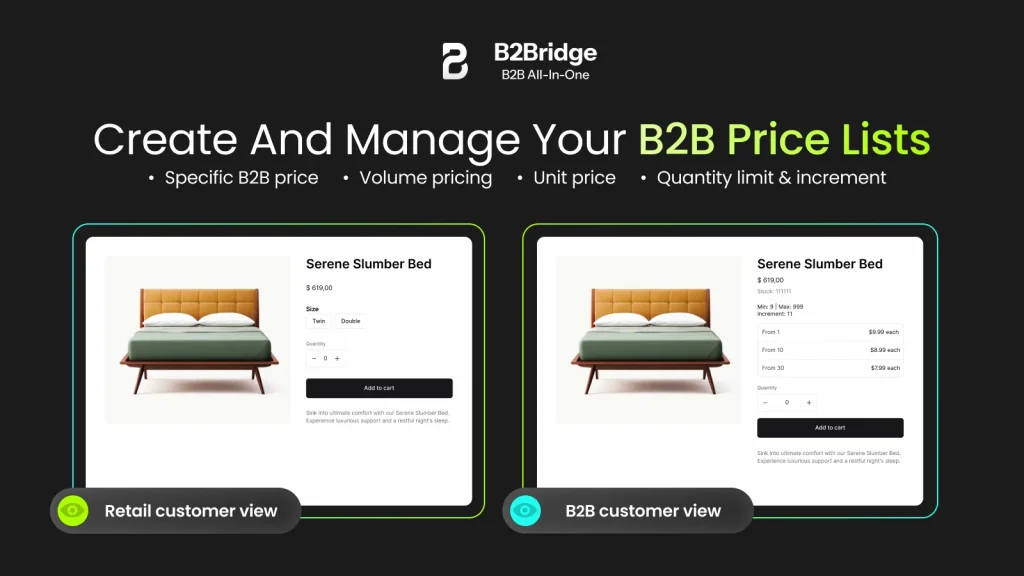
Volume pricing—where the price per unit decreases as quantity increases—is a proven way to encourage larger orders. When buyers can see exactly how much they save by ordering 100 units instead of 50, they often choose the bigger order.
Tiered pricing tables displayed directly on product pages remove the guesswork and create a natural incentive to buy more.
6. Improved B2B customer experience and buyer retention
B2B buyers now expect the same convenience experience they get as consumers. Quick reordering, saved carts, and account dashboards aren’t nice-to-haves anymore—they’re baseline expectations.
When you make purchasing easy, buyers come back. When you make it frustrating, they find a competitor who doesn’t.

7. Faster quote to order and RFQ workflows
For complex or high-value purchases, buyers often request a quote before committing. RFQ (Request for Quote) workflows let buyers submit quote requests directly from your site, which you can review, adjust, and convert into orders—all within the platform.
RFQ workflows replace the back-and-forth email chains that slow deals down and lose context. Digital quoting keeps everything tracked and moves buyers through the funnel faster.
8. Flexible net payment terms for wholesale buyers
Net terms—Net 15, Net 30, Net 60—let buyers pay after receiving goods rather than at checkout. For many B2B buyers, net terms aren’t a preference; they’re a procurement requirement.
Offering payment flexibility strengthens relationships and removes a significant barrier to purchase. Buyers who can’t pay on terms often can’t buy at all.
9. ERP and CRM integration for synced data
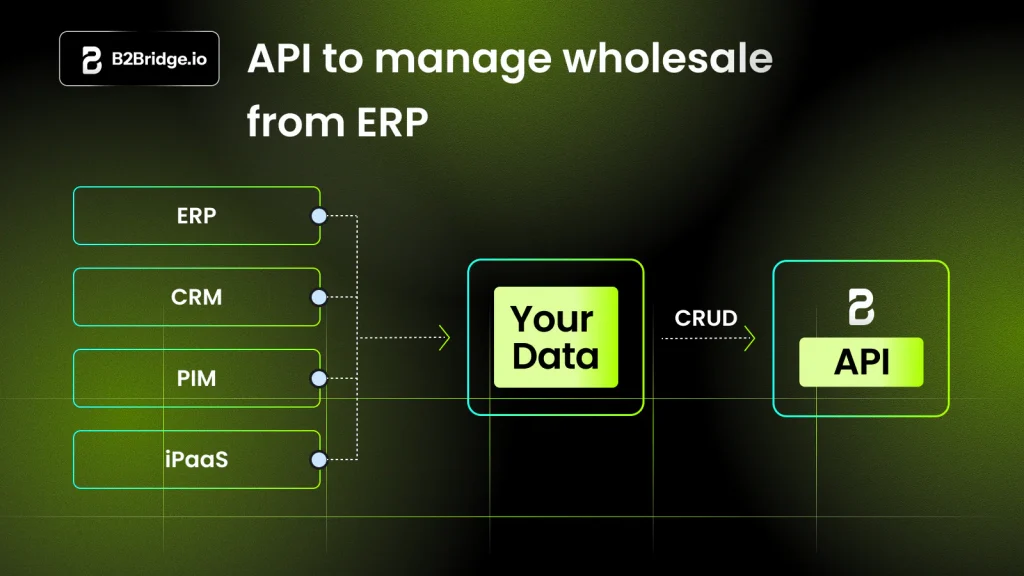
When your ecommerce platform talks to your ERP (Enterprise Resource Planning) and CRM (Customer Relationship Management) systems, data stays consistent everywhere. Pricing updates in your ERP flow to your storefront automatically, and new customer accounts sync across systems without manual entry.
- Pricing sync: ERP-managed price lists flow to storefront automatically
- Customer sync: New accounts and tags update across systems
- Order sync: Orders flow to fulfillment without manual entry
The alternative—manually updating multiple systems—is slow, error-prone, and doesn’t scale.
10. Better order accuracy and inventory control
Real-time inventory visibility prevents overselling and backorder headaches. When your storefront reflects actual stock levels, buyers know what’s available before they order.
Automated order capture also eliminates the transcription errors that happen when someone manually enters orders from emails or phone calls.
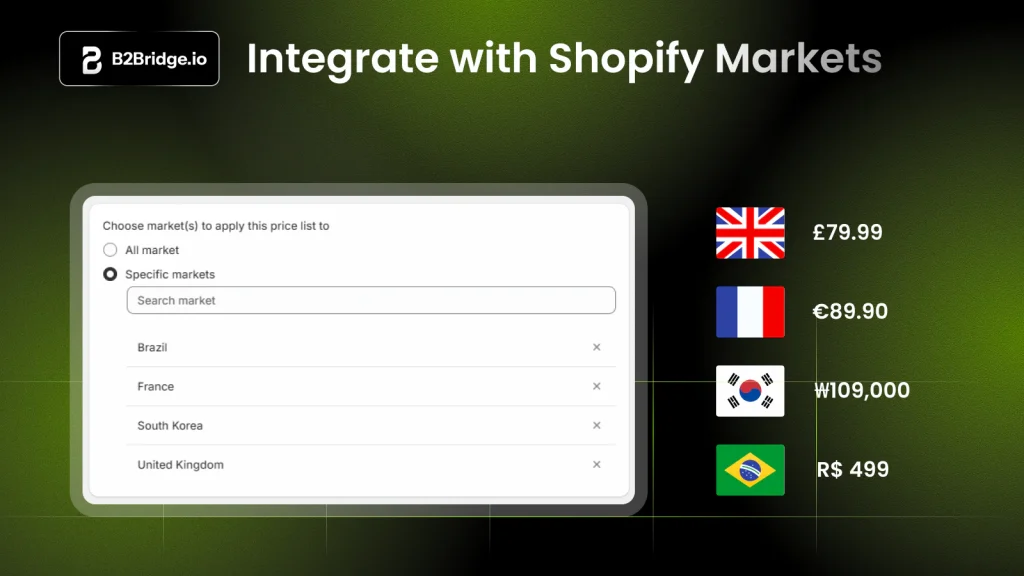
11. Expanded global reach with multi currency selling
An online presence removes geographic limitations. Buyers in other countries can browse your catalog, see prices in their currency, and place orders without international phone calls or time zone coordination.
Multi-currency support removes friction for international buyers and opens markets that would otherwise require local sales teams.
12. Unified B2B and B2C operations on one store
Running separate B2B and B2C stores means double the maintenance, double the inventory management, and double the potential for errors. A unified store—where wholesale buyers see different pricing and catalogs than retail customers—consolidates operations without compromising either experience.
A unified B2B and B2C approach is increasingly popular on Shopify, where apps can layer B2B functionality onto existing DTC stores.
13. Scalable growth without adding headcount
Scalability means handling more orders, more customers, and higher volume without proportionally increasing staff. Self-service ordering reduces the burden on sales reps, and automation handles the repetitive tasks that would otherwise require new hires.
The businesses that scale most efficiently are the ones where revenue grows faster than headcount.
14. Real time reporting and data driven insights
B2B ecommerce platforms capture data on every transaction, every buyer, and every product. Real-time visibility supports better decisions—from identifying your fastest-moving products to understanding which customer segments drive the most revenue.
- Customer insights: Track buying patterns and preferences
- Sales analytics: Monitor revenue by product, region, or customer segment
- Inventory intelligence: Identify fast-moving and slow-moving stock
Common Challenges to Plan for With B2B Ecommerce
Now that the advantages are clear, here are the obstacles worth anticipating. None of the following challenges are dealbreakers, but planning for them upfront saves headaches later.
Disconnected ERP and storefront data
When your ecommerce platform and ERP don’t communicate, pricing discrepancies and inventory mismatches become routine. The fix is proper integration—either through native connectors or robust APIs—but integration requires planning during platform selection.
Complex pricing rules and customer segmentation
Managing multiple price lists, volume rules, and customer groups manually is unsustainable at scale. Native ecommerce platforms often lack pricing complexity capability, which is why specialized B2B apps exist to fill the gap.
Buyer adoption and change management
Transitioning buyers from phone or email ordering to self-service requires communication and sometimes training. Buyers who’ve ordered the same way for years may resist change—even when the new way is objectively better.
What to Look for in a B2B Ecommerce Platform
The features that unlock the advantages above aren’t universal. Here’s what to evaluate when choosing a platform.
Pricing engine flexibility
Look for unlimited price lists, customer-group pricing, volume tiers, quantity rules, and contract pricing. The platform handles complex wholesale logic natively when it offers pricing engine flexibility, not through workarounds.
ERP and CRM integration depth
Native connectors or robust APIs for syncing pricing, customers, and orders with systems like NetSuite, Zoho, and Odoo are essential. Ask specifically about the integrations you use.
B2B buyer experience and UX
Quick order forms, saved carts, reorder functionality, and account management portals matter. Buyers expect fast, frictionless purchasing—not a clunky interface designed for retail.
Access control and wholesale registration
The ability to gate pricing and products for logged-in buyers only protects your wholesale margins. Registration forms that verify and onboard new wholesale accounts streamline the approval process.
How to Capture These Advantages With B2Bridge on Shopify
B2Bridge delivers all 14 advantages within Shopify—without requiring Shopify Plus or a separate B2B platform. B2Bridge is built for manufacturers, distributors, and wholesalers who want enterprise-grade B2B functionality on their existing store.
- B2B Pricing Engine: Role-based/company-based pricing, contract price lists, customer group, volume rules, min/max quantities, credit limits
- ERP/CRM Integration: Sync with NetSuite, Zoho, Odoo, and custom ERPs via enterprise API
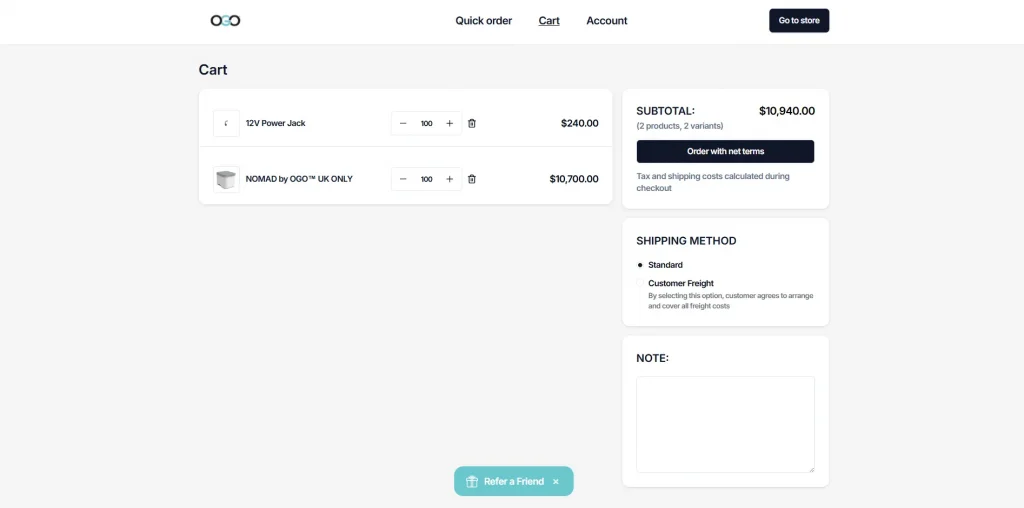
- B2B Buyer UX: Quick order pages, dedicated B2B cart with net terms, RFQ workflows
- Unified Operations: Run B2B and B2C from one Shopify store
The result is a wholesale operation that runs faster, with fewer errors, and without the complexity of managing multiple platforms.

The Future of B2B Ecommerce
Buyer expectations continue rising. The convenience that B2C shoppers take for granted—personalized recommendations, mobile-first experiences, instant answers—is becoming the baseline for B2B as well.
Deeper system integrations, AI-powered personalization, and mobile ordering are all accelerating. The businesses investing in B2B ecommerce capabilities now are positioning themselves ahead of competitors still relying on manual processes.
>> See more: 12 B2B Ecommerce Trends Reshaping How Businesses Buy in 2026
Frequently Asked Questions About B2B Ecommerce Advantages
Is B2B ecommerce only for large enterprises?
No. B2B ecommerce benefits businesses of all sizes, from growing wholesale brands to established distributors. Automation and self-service ordering deliver value regardless of team size—often more value for smaller teams with limited resources.
Can I run B2B and B2C sales on the same Shopify store?
Yes. With the right app, you can operate a unified B2B and B2C store on Shopify, showing different pricing and catalogs to wholesale buyers versus retail customers. A unified store eliminates the need for separate storefronts.
How long does it take to launch a B2B ecommerce store?
Timeline varies by complexity, but many merchants launch basic B2B functionality within days using apps that layer onto existing Shopify stores. More complex implementations with ERP integrations typically take a few weeks.
Do I need Shopify Plus to sell B2B on Shopify?
No. Apps like B2Bridge provide enterprise-grade B2B capabilities—including pricing, net terms, registration, and access control—on standard Shopify plans without requiring Shopify Plus.
How does B2B ecommerce impact sales rep productivity?
B2B ecommerce increases sales rep productivity by eliminating manual order entry and routine inquiries. Reps can focus on relationship building, closing larger deals, and supporting complex accounts rather than processing orders that buyers could place themselves.

Hi, I’m Hanh – a product marketing professional passionate about driving growth, simplifying complex solutions, and creating impactful strategies for Shopify that connect products with customers.