Traffic keeps getting more expensive for Shopify stores. That pushes growth toward a different question: how much more can each existing shopper spend per order?
The metric behind that question is average order value (AOV). Product bundling is one of the most direct ways to move it, and it goes further than a flat “Buy 2, save 10%.” Shopify merchants can combine quantity breaks, mix-and-match offers, complementary sets and milestone rewards to give shoppers a real reason to add more.
This guide walks through eight bundling strategies, how to protect margin while running them, and what changes when some of your buyers are wholesale accounts.
Why average order value matters
Average order value is total revenue divided by the number of orders. A store that makes $10,000 from 200 orders has an AOV of $50.
Raise that AOV to $60 and the same 200 orders bring in $12,000. You haven’t paid for a single extra click. When acquisition costs climb, that gap is often the cheapest revenue a store can find.
The catch is that shoppers need a reason to buy more. Pushing extra products at them rarely works. A well-built bundle gives them that reason, which is where the strategies below come in.
1. Use quantity bundles to lift units per order
A quantity bundle rewards shoppers for buying more units of the same product. The shopper sees the saving at each step before adding to cart.
| Quantity | Offer |
|---|---|
| Buy 1 | Regular price |
| Buy 2 | Save 10% |
| Buy 3 | Save 15% |
This works best for products people reorder or use in multiples, such as skincare, supplements, pet food and household refills. Keep the tiers simple. A shopper should grasp the deal in a few seconds.
2. Create complementary product bundles
A bundle doesn’t have to repeat one SKU. Products that naturally belong together can be sold as one set.
| Category | Example bundle |
|---|---|
| Skincare | Cleanser + serum + moisturizer |
| Fashion | Shirt + trousers + accessory |
| Jewelry | Necklace + earrings + bracelet |
| Fitness | Protein + shaker + supplement |
| Beauty | Foundation + concealer + setting powder |
The shopper no longer has to find each item on its own. The bundle hands them a complete solution, which raises order value and makes the decision easier.
3. Let customers build their own bundle
Fixed sets suit products with an obvious link. Some shoppers want more control.
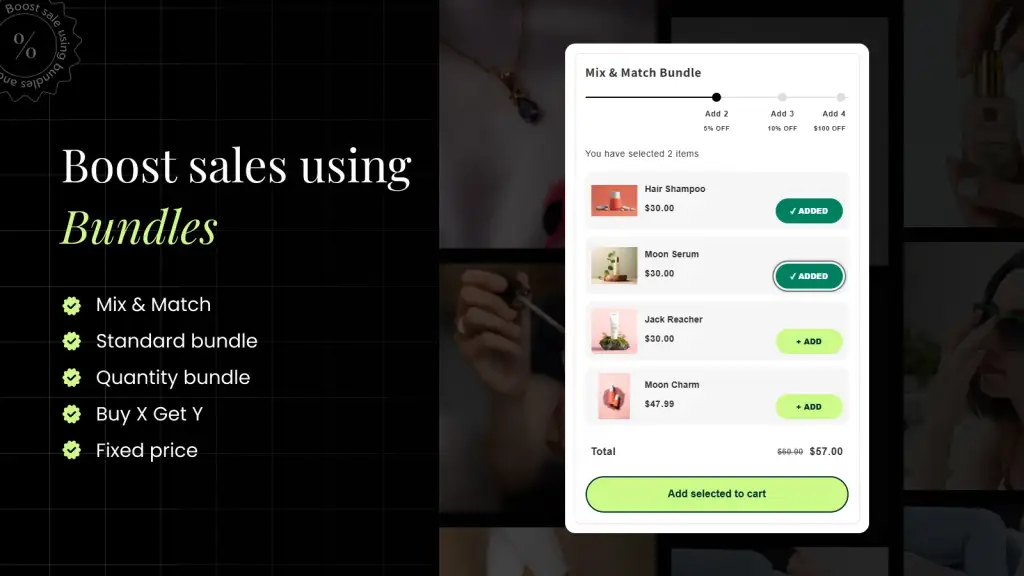
A mix-and-match bundle lets them pick the products or variants they want and still earn the incentive, for example “Choose any 3 products and save 10%.” The minimum quantity keeps AOV up while the choice stays with the shopper. It’s especially useful for stores that sell many flavors, colors, sizes or scents.
4. Go beyond discounts with milestone gifts
What if the incentive isn’t a lower price at all? A milestone gift rewards shoppers when their cart crosses a set value.
| Cart value | Reward |
|---|---|
| $50 | Free gift unlocked |
| $75 | Second reward unlocked |
| $100 | Premium gift unlocked |
The shopper gets something to work toward, and the margin stays intact. Someone sitting at $68 has a clear reason to add one more item to reach $75. That sense of progress is what a flat discount can’t create.
BundleBox: Bundle Builder by Slash Themes pairs standard bundles with a Milestone Gift feature. Merchants can run quantity bundles, product bundles, mix-and-match offers and milestone gifts from one app.
5. Use bundles for product discovery
Bundles can also introduce shoppers to products they haven’t tried. A brand with six skincare products might build a starter kit with smaller sizes of its best sellers.
A shopper who came for one product leaves with several. If they like them, they’re likely to come back for full sizes. The bundle lifts AOV today and seeds repeat orders later.
6. Build bundles around customer intent
A common mistake is grouping products because the store wants to move them. Shoppers notice when a bundle feels forced.
Start from a different question. Instead of “Which products do we want customers to buy?”, ask “Which products would customers buy together anyway?” A “Complete Morning Skincare Routine” solves a specific need. A random mix of slow sellers doesn’t. The best bundles have an obvious reason to exist.
7. Keep bundle savings easy to understand
Complicated promotions add friction. If shoppers have to calculate stacked discounts or read the fine print, many will skip the offer.
Clear wording looks like “Buy 2 & Save 10%”, “Choose Any 4 for $49” or “Spend $75 & Unlock a Free Gift.” Each tells the shopper what to do and what they’ll get, in one line.
8. Test different bundle offers
No single bundle setup works for every Shopify store. Treat each offer as a test and change one variable at a time.
Variables worth testing:
- Bundle quantities and discount percentages
- Product combinations
- Gift thresholds
- Placement on product, cart and collection pages
- Offer wording
Metrics to compare:
- Average order value
- Bundle conversion rate
- Items per order
- Revenue per visitor
- Discount and gift cost
A bundle that lots of shoppers use can still lose money. The goal is better store economics, which the next section covers.
Bundling without destroying margin
A higher AOV doesn’t guarantee higher profit. A deep discount on a three-product bundle can raise order value and still shrink contribution margin.
Before launching an offer, add up product cost, fulfillment, shipping, payment fees and the cost of any free gift. Then check the bundle price against that total.
This is where milestone gifts earn their place. A product that costs the store little but feels valuable to the shopper can drive the extra add-to-cart without a large percentage off.
What changes when you also sell wholesale?
Many Shopify brands run retail and wholesale from the same store. Bundles built for retail shoppers can cause trouble once trade buyers see them.
The main risk is stacking. A 15% bundle discount applied on top of a wholesale price list can push an order below cost. Most merchants keep retail bundles and milestone gifts limited to retail customers, and give wholesale buyers their own incentives.
Those incentives look different. Trade buyers respond to volume pricing (a lower unit price at 24, 48 or 96 units) and clear minimum order quantities, because they’re buying stock to resell. A wholesale app such as B2Bridge manages those price lists, quantity breaks and order minimums for approved accounts, while a bundle app handles the retail storefront.

The future of Shopify bundling is more personalized
Static bundles will stay useful. Merchants now have room to make offers more interactive, mixing quantity breaks, build-your-own sets, complementary picks and milestone rewards.
The principle is the same throughout: give customers more value when they buy more. Done with care for margin and for the type of buyer, bundling raises AOV and makes buying easier at the same time.
For merchants who want to test several bundle types in one place, BundleBox: Bundle Builder by Slash Themes covers quantity bundles, product bundles, mix-and-match offers and Milestone Gifts directly on Shopify.
Explore BundleBox on the Shopify App Store

As a Product Marketing Executive at B2Bridge, I focus on the Enterprise B2B Ecommerce domain. I leverage my understanding of product and user psychology to deliver customer-centric content that addresses business challenges and fuels growth.