Wholesale pricing apps look interchangeable on a feature checklist. They stop looking alike the moment your catalog outgrows a tier or your reps start ordering on behalf of customers. They diverge again when your finance team asks who owes what. That’s where B2Bridge and Clay separate.
Both are Built for Shopify apps with 5.0-star ratings. Both handle custom pricing, volume tiers, and wholesale registration. Which one belongs on your store? Here’s what the checklists leave out: plan caps, gated features, real total cost, and the workflows only one of them supports.
B2Bridge vs Clay at a Glance
B2Bridge and Clay are both Built for Shopify wholesale apps, but they solve different sizes of problem. Clay is a focused pricing and registration app from $25/month, capped by how many SKUs you can price. B2Bridge is an all-in-one B2B app from $99/month with unlimited price lists, orders, and customer groups, plus reps, quotes, credit limits, and an API.
Here’s how they line up. Every figure was verified in August 2026.
| B2Bridge | Clay | |
|---|---|---|
| Rating | 5.0 | 5.0 |
| Reviews | 25 | 260 |
| Built for Shopify | Yes | Yes |
| Free plan | Yes | Yes |
| Free trial | 14 days | 7 days |
| Entry paid plan | $99/mo | $25/mo |
| Top published plan | $299/mo | $99/mo |
| SKU cap | No cap | 100 to 100,000 by tier |
| Unlimited price lists | $99 | Not capped by list |
| Net terms | Free plan | $49 |
| Volume and tiered pricing | Free plan | $25 |
| Quote requests (RFQ) | $199 | Not available |
| Sales rep portal | $199 | Not available |
| Credit limits | $199 | Not available |
| Company accounts | $199 | Free plan |
| Public API | $299 | $99 (prices only) |
| Shopify POS | $99 | $49 |
What Each App Is Built to Do
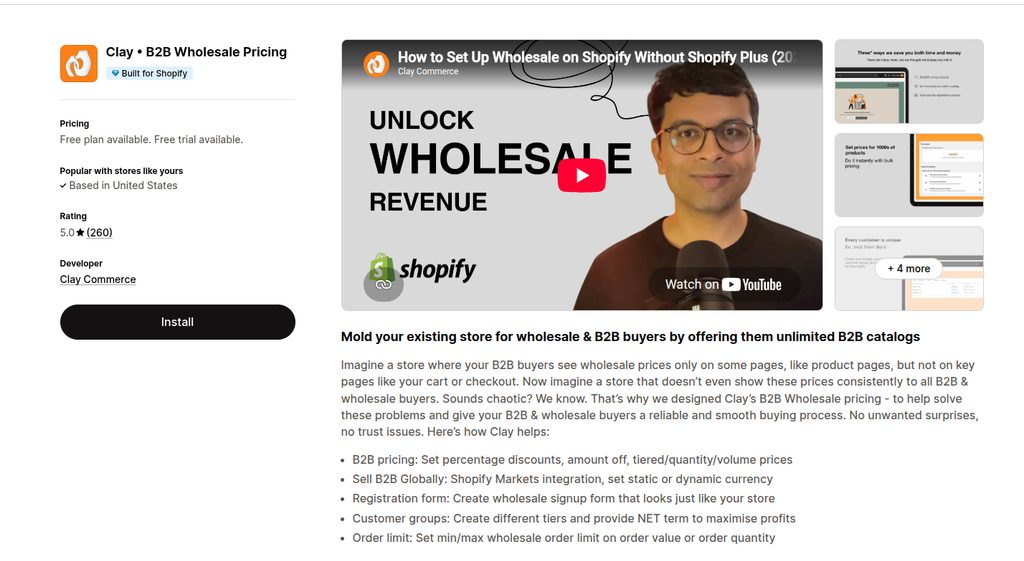
Clay is a pricing layer for your existing store. It’s there to make sure a logged-in wholesale buyer sees the same price on your product page, in your cart, and at checkout. Prices that shift between those pages break trust with B2B buyers. Around that it adds a branded registration form, tax ID uploads, VIES VAT validation, and order limits. The scope is narrow on purpose, and if you only need correct prices, narrow is cheaper.
B2Bridge is built for the operation behind your prices. It covers pricing too, then keeps going into quoting, credit control, rep ordering, company accounts, and ERP sync through a public API. It’s built for merchants whose wholesale channel runs on people and processes, not just a discount percentage. Clay solves a display problem. B2Bridge solves a workflow problem.

Wholesale Pricing and Price Lists Compared
Both apps cover the pricing fundamentals, and they cover them well. Percentage discounts, fixed amount off, quantity and volume tiers, prices set independently of retail, CSV bulk upload. All present in both. Clay even puts basic wholesale pricing and discounts on its free plan. If your requirement stops at “show my wholesale customers their own prices,” either app clears the bar.
The differences start at the edges. Clay can calculate B2B prices from your cost price on its $49 Gloss plan, which is genuinely useful for cost-plus wholesale, and B2Bridge has no equivalent. B2Bridge prices per product variant, handles VAT dual pricing, and lifts every list, group, and order limit at $99.
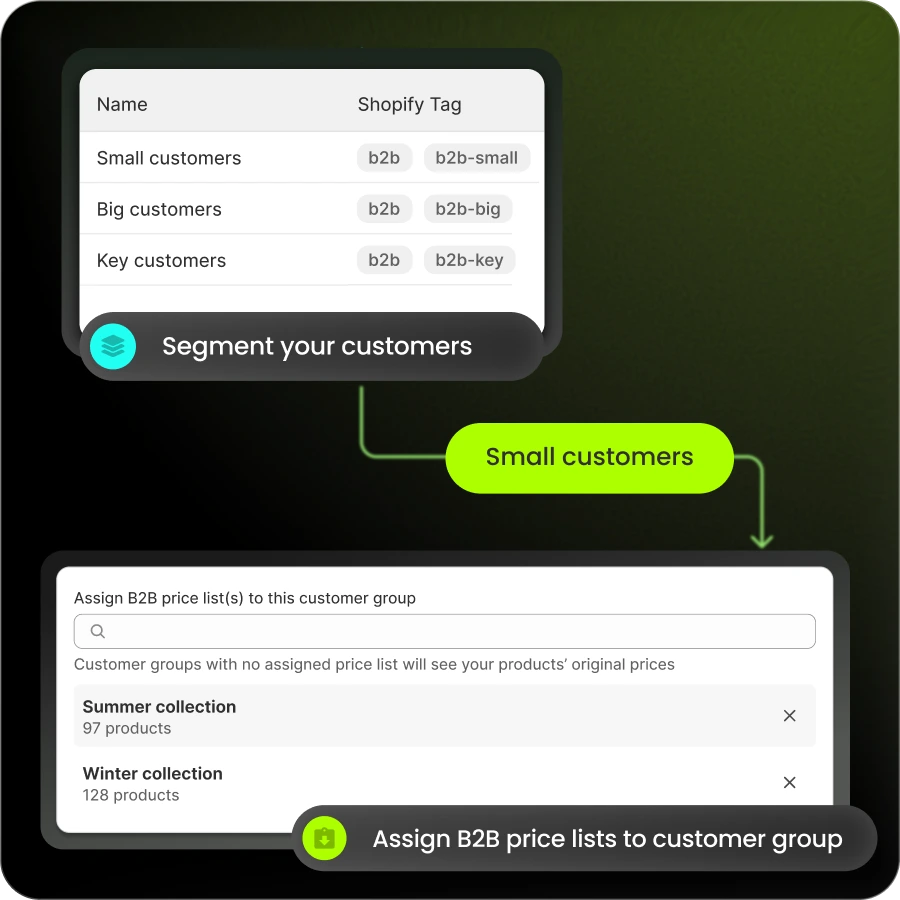
Where B2Bridge pulls ahead is segmentation depth. A price list maps to a customer group, a group maps to customers, and none of those counts are capped on a paid plan. Managing customer groups with different pricing in Shopify stays workable at 5 tiers or 50.
Where Each App Stops Scaling
Clay’s plans cap the number of SKUs you can price. The ceilings are 100 on the free plan, 1,000 on Matte, 10,000 on Gloss, and 100,000 on Luster. B2Bridge publishes no SKU cap on any tier, and its own limits (price lists, customer groups, B2B orders) all lift at $99.
Here’s what’s worth naming honestly. Clay’s listing headline promises “unlimited B2B catalogs” while the plans meter priced SKUs. And B2Bridge’s free Starter plan is tighter than Clay’s in its own way, allowing 1 price list and just 5 B2B orders per month.
| Limit | B2Bridge | Clay |
|---|---|---|
| Priced SKUs | None published | 100 / 1K / 10K / 100K |
| Price lists | Unlimited from $99 | Not metered |
| B2B orders | 5/mo free, unlimited from $99 | Not metered |
| Customer groups | Unlimited from $99 | Not metered |
| Sales agents | Unlimited from $199 | Not applicable |
Which limit bites first? For a 30,000-SKU catalog, Clay forces the $99 tier before you’ve priced anything. For a 400-SKU catalog with three tiers, neither app blinks. Catalog size drives Clay’s bill, and workflow complexity drives B2Bridge’s.
Net Terms, Credit Limits, and Quote Requests
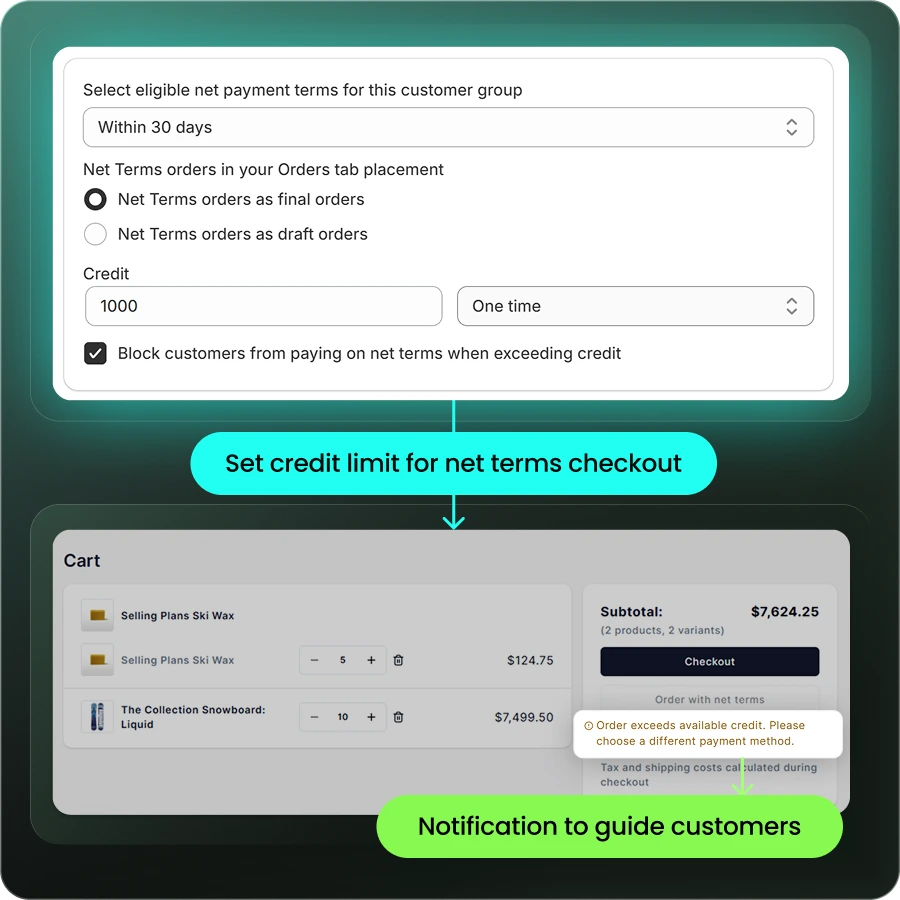
Clay supports net terms from its $49 Gloss plan and has no credit limits or quote engine. B2Bridge includes net terms on its free plan, then adds credit limits and RFQ at $199. That’s the sharpest functional gap between the two apps.
Why do credit limits matter more than merchants expect? Net terms without an exposure ceiling is unsecured lending. B2Bridge sets a limit per company, and buyers who exceed it can’t place new orders until invoices clear. Some buyers never pay.
Quote requests fill the other half. B2Bridge lets your buyers submit an RFQ, auto-approves quotes against rules, exports a PDF, and converts the accepted quote into an order. Clay’s closest equivalent is a manual draft order the merchant builds, which works but keeps the work on your side of the desk. If you’re weighing how net payment terms actually get calculated, the credit-limit question comes with it.
Sales Rep and Company Account Workflows
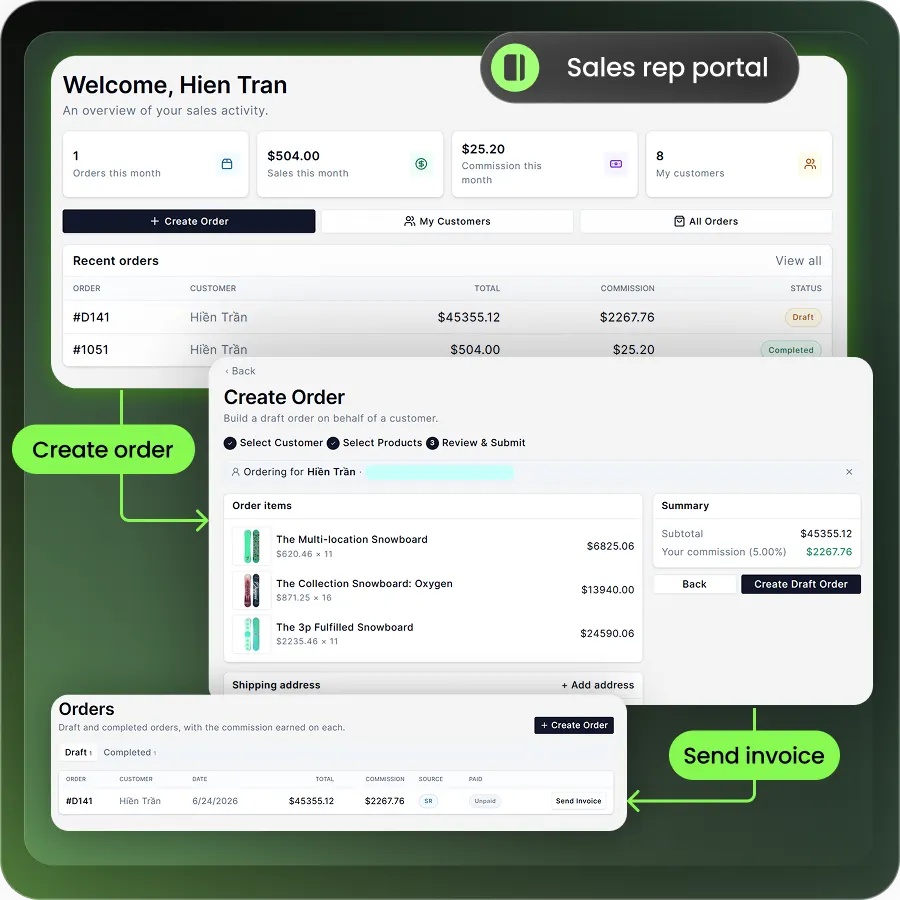
Clay has no sales rep portal. B2Bridge includes unlimited sales agents at $199, and it’s the feature that most often decides this comparison outright.
What does that look like day to day? A rep logs into their own portal, sees the accounts assigned to them, and places orders on behalf of those customers at each customer’s contracted prices. They see that account’s order history. They never touch Shopify Admin. No waiting for a merchant to key in a phone order.
Credit where it’s due on the buyer side: Clay’s free plan creates Shopify B2B company accounts, so multiple people from one business can order under a shared account. B2Bridge puts unlimited company accounts at $199 instead. If team ordering is the whole requirement, Clay delivers it for nothing, a real advantage. A full Shopify B2B portal needs both sides.
ERP Sync and API Access Compared
Clay exposes a price-update API endpoint on its $99 Luster plan. B2Bridge’s Public API arrives at $299 and covers price lists and customer records, which is what two-way sync with NetSuite, Zoho, or Odoo actually requires.
The trade-off is clean. If your only integration need is pushing prices from another system into Shopify, Clay does it for $200 less per month. If your ERP owns pricing and customer data, a prices-only endpoint leaves half the job manual.
That’s the enterprise end of B2Bridge’s range. Brooklyn Bicycle runs its wholesale portal on B2Bridge with NetSuite sync, and that class of build is why the Advanced plan exists alongside a 1-on-1 onboarding process. Match the API scope to what your ERP owns rather than to the price.
Pricing Plans and Total Cost Compared
Clay starts at $25/month and tops out at $99. B2Bridge starts at $99 and runs to $299, with custom Enterprise pricing above that. Both offer a free plan; Clay’s trial is 7 days, B2Bridge’s is 14.
| Plan | Price | What it unlocks |
|---|---|---|
| Clay Free | $0 | Wholesale pricing, registration form, VIES VAT check, company accounts, 100 SKUs |
| Clay Matte | $25 | Volume tiers, CSV upload, order limits, 1K SKUs |
| Clay Gloss | $49 | Net terms, cost-based pricing, draft orders, POS discounts, 10K SKUs |
| Clay Luster | $99 | Markets multi-currency, quick order, price API, tax display, 100K SKUs |
| B2Bridge Starter | $0 | Net terms, volume discount, registration, quick order, 5 orders/mo |
| B2Bridge Professional | $99 | Unlimited price lists, orders and groups, POS, hide price, reorder |
| B2Bridge Growth | $199 | Sales rep portal, RFQ, credit limits, unlimited company accounts, 1-on-1 onboarding |
| B2Bridge Advanced | $299 | Public API, customization on request, VIP video support |
Is B2Bridge more expensive? At feature parity, no. Clay simply doesn’t sell reps, quotes, or credit control at any price. Compare $99 to $99 and the split is your catalog size versus unlimited operations.
Which App Fits Your Wholesale Operation
Should the budget decide, or the workflow? Start from your workflow. The features you’ll need in twelve months decide this better than the invoice you’ll pay next month.
| Your situation | Better fit | Why |
|---|---|---|
| Pricing only, catalog under 1,000 SKUs | Clay | $25 covers it |
| Cost-plus wholesale pricing | Clay | Cost-based pricing at $49 |
| Tightest possible budget | Clay | Lower entry, stronger free tier |
| Reps ordering on behalf of accounts | B2Bridge | Only one of the two offers it |
| Quotes plus credit control | B2Bridge | RFQ and credit limits at $199 |
| ERP owns prices and customers | B2Bridge | Full Public API at $299 |
| Catalog past 10,000 SKUs | B2Bridge | No published SKU cap |
| Scaling to many customer tiers | B2Bridge | Unlimited price lists and groups |
One honest caveat before you decide: Clay has 260 reviews to B2Bridge’s 25. Both sit at 5.0 with a Built for Shopify badge, but Clay has more merchants on record. B2Bridge answers that with published customer stories and hands-on implementation rather than volume.
Run Your Shopify Wholesale Channel with B2Bridge
Which problem are you actually solving? If your wholesale channel is a pricing problem, Clay is a sound, affordable choice and we’d rather you knew that. If it’s an operations problem, B2Bridge is built for the part Clay doesn’t cover.
B2Bridge doesn’t penalize you for growing. Unlimited price lists, B2B orders, and customer groups from $99, with no published SKU ceiling, and one app instead of a stack:
- Customer-specific pricing per variant, volume tiers, MOQ, and quantity increments
- Net terms with credit limits, plus RFQ that converts quotes to orders
- Sales Rep Portal with unlimited agents ordering on behalf of assigned accounts
- Unlimited company accounts and per-customer B2B shipping rates
- Public API for NetSuite, Zoho, and Odoo sync
- Deep Shopify integration across POS, Markets, and Translate

Every plan comes with a real implementation path for your build, from discovery call to go-live, backed by BSS Commerce. Check the current plans or Book a Demo and we’ll map your workflow before you install anything.
FAQs about B2Bridge and Clay
Is Clay cheaper than B2Bridge for a small wholesale catalog?
Yes. Clay’s $25 Matte plan covers volume pricing for up to 1,000 SKUs, while B2Bridge’s first paid tier is $99. Both offer free plans with different limits.
Does Clay have a sales rep portal?
No. Clay’s published plans include no sales rep portal or agent ordering. B2Bridge includes unlimited sales agents on its $199 Growth plan, ordering on behalf of assigned accounts.
Can I run both Clay and B2Bridge on the same store?
Technically yes, but you shouldn’t. Two apps rewriting displayed prices on the same theme will conflict at cart and checkout. Pick one and migrate your price lists cleanly.
Do I need Shopify Plus to use either app?
No. Both apps work on standard Shopify plans, and Shopify’s native B2B features became free on all plans in April 2026. Non-Plus stores are capped at 3 native catalogs.
How long does it take to launch a B2B store with either app?
Clay’s live in a day for basic pricing. B2Bridge builds involving reps, RFQ, or ERP sync typically run a few weeks, which is why onboarding is included from the Growth plan.

As a Product Marketing Executive at B2Bridge, I focus on the Enterprise B2B Ecommerce domain. I leverage my understanding of product and user psychology to deliver customer-centric content that addresses business challenges and fuels growth.