Choosing between B2Bridge and SparkLayer often comes down to one question: do you need deep customization for a complex, catalog-separated wholesale operation, or do you need a scalable self-service platform with a built-in sales team portal? Both apps target serious B2B merchants on Shopify, but they’re built around fundamentally different assumptions about how wholesale businesses sell. This article compares both platforms across architecture, pricing, core features, and key use cases — so you can identify which fits your operation before committing.
B2Bridge vs SparkLayer at a Glance
Both apps deliver enterprise B2B functionality on Shopify without requiring Shopify Plus. The table below shows where they diverge across the dimensions that matter most.
| Criteria | B2Bridge | SparkLayer |
| Best for | Complex, catalog-separated B2B operations | Wholesale brands with active sales teams |
| Starting price | $99/mo | Free (5 orders/mo), $49/mo paid |
| Order volume limits | None | Up to 150 orders/mo (Pro plan) |
| B2B/B2C separation | Full storefront separation | Overlay on existing storefront |
| RFQ / Quoting | Growth plan ($199/mo) | Pro plan ($299/mo) only |
| Public API | Advanced plan ($299/mo) | Pro plan ($299/mo) |
| Sales Agent Portal | Not available | From Starter plan ($49/mo) |
| Custom development | Yes — consultative model | Not clearly offered |
| ERP integrations | NetSuite, Zoho, Odoo | Xero, QuickBooks, Cin7, Unleashed |
| Shopify POS | Not supported | Not supported |
If you run a field sales team that regularly places orders on behalf of buyers, SparkLayer’s Sales Agent Portal is a genuine differentiator. If you need strict catalog separation between B2B and Business-to-Consumer (B2C) buyers — or require workflows your Enterprise Resource Planning (ERP) team dictates — B2Bridge fits that architecture better.
What Is B2Bridge

B2Bridge is an enterprise B2B ecommerce solution for Shopify that enables merchants to run a complete wholesale operation — custom pricing, gated catalog access, net payment terms, and bulk ordering — without upgrading to Shopify Plus.
The core mechanic maps Price Lists to Customer Groups to Customers. Wholesale buyers must log in before they see assigned prices. This login-gated model keeps retail and wholesale experiences architecturally isolated on the same Shopify store.
Core capabilities:
- Price List + Customer Group: Unlimited price lists with percentage, fixed, or new price types; volume discount tiers; minimum order quantity (MOQ) enforcement; and regional pricing via Shopify Markets.
- B2B Lock: Login-required, password, or page-level locks that hide prices and catalog sections from retail visitors.
- Net Payment Terms: Net 15, 30, 60, or 90 checkout flows, configured per Customer Group.
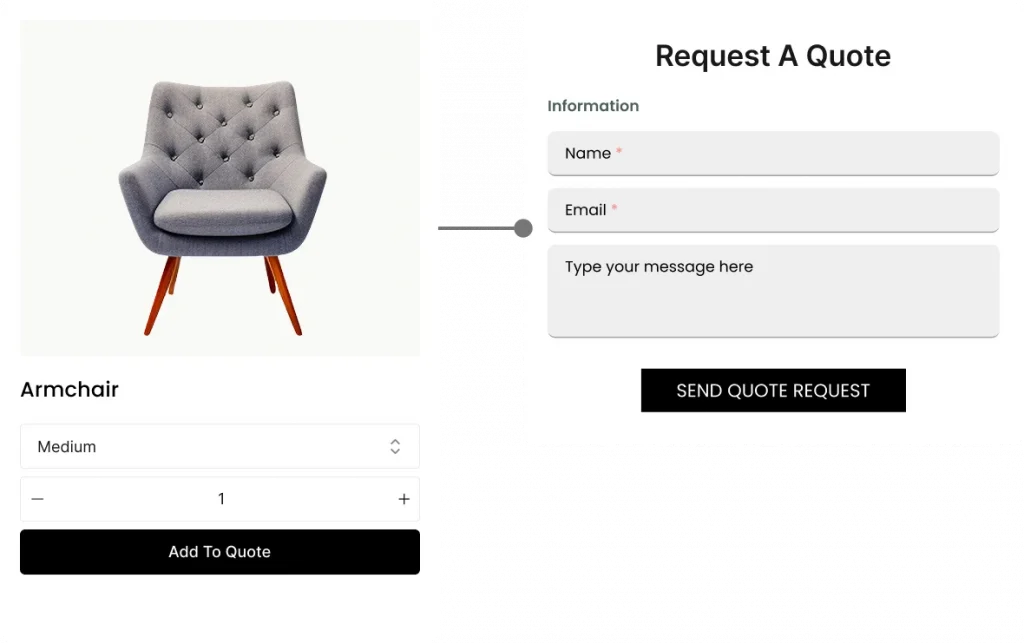
- RFQ: Request for Quote (RFQ) workflow where buyers submit quote requests; merchants review and convert accepted quotes to draft orders. Growth plan and above.
- Public API: Application Programming Interface (API) access to Customer Groups and Price Lists for ERP sync. Advanced plan.
- Override Price: Sets the actual Shopify variant price for logged-in buyers — not a discount code — keeping revenue reports accurate.
Pros
- Full B2B/B2C storefront separation — product pages, collection pages, and cart use separate templates for wholesale buyers.
- All-in-one platform: pricing, locking, registration, RFQ, and net terms in one subscription.
- Consultative onboarding — adapts to your workflows rather than forcing a template.
- No order volume caps — flat monthly pricing regardless of order count.
Cons
- No Sales Agent Portal — reps cannot log in to place orders on behalf of buyers.
- No native Shopify POS integration.
What Is SparkLayer

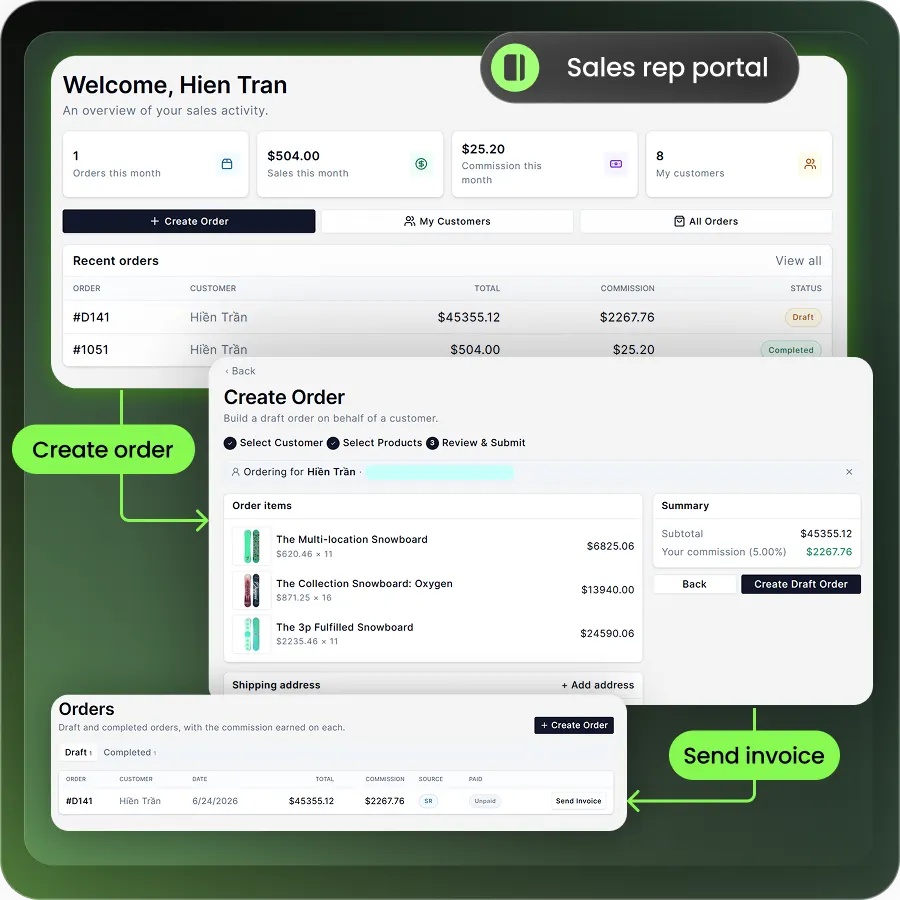
SparkLayer is a B2B wholesale ordering layer that installs on top of an existing Shopify store — turning it into a self-service wholesale portal without rebuilding the storefront. Think of it like installing a dedicated wholesale lane inside your existing retail store: the building stays the same, but approved buyers get a different checkout experience.
The platform focuses on two core outcomes: fast self-service ordering for wholesale buyers, and a sales team portal that lets reps act on behalf of any approved account. Both are available from the entry-level paid plan.
Core capabilities:
- Sales Agent Portal: Reps log into the storefront, toggle between customer accounts, build carts, and place orders on a buyer’s behalf — no admin access required.
- Quoting Engine: End-to-end quote workflow with a built-in messenger, live price adjustment, and PDF download. Pro plan only.
- AI Intelligent Cart: Buyers upload a PDF, email, or spreadsheet; SparkLayer automatically builds the cart from the file.
- ERP integrations: Native connectors to Xero, QuickBooks, Cin7, Unleashed, Linnworks, and Brightpearl.
- B2B Analytics: Customer-level tracking, Sales Agent performance, and commission support.
Pros
- Sales Agent Portal available from $49/mo — earliest access among major B2B Shopify apps.
- Broad ERP/accounting ecosystem with pre-built, no-code connectors.
- AI Intelligent Cart converts buyers who order by spreadsheet into online orderers.
- Free plan available for merchants validating demand before committing to a paid tier.
Cons
- Hard monthly order caps — Pro plan ($299/mo) limits you to 150 B2B orders per month.
- Quoting Engine and API access locked to the highest-tier plan.
- No true B2B/B2C storefront separation — both audiences share the same Shopify theme.
- Custom development per merchant requirements not clearly offered.
- Difficult learning curve
>> See more: Sparklayer Review 2026: Pros, Cons & Best Alternative
Key Differences Between B2Bridge and SparkLayer
The most important differences between these two platforms aren’t feature-level — they’re architectural. Choosing based on a feature checklist often leads to the wrong call. Understanding the structural tradeoffs upfront prevents misalignment after setup, after onboarding, and after your team has built workflows around the wrong tool.
1. Storefront Architecture
B2Bridge replaces core Shopify storefront components — product pages, collection pages, and cart — with B2B-specific versions for logged-in wholesale buyers. Retail and wholesale experiences run on different templates and display different pricing, products, and checkout flows.

SparkLayer overlays B2B ordering features onto the existing Shopify theme. Both buyer types share the same storefront structure, with B2B pricing and controls activating after login.
- B2Bridge: Wholesale buyers see separate product cards, pricing, and cart logic from retail visitors.
- SparkLayer: Same storefront for all visitors; B2B features activate after buyer authentication.
While SparkLayer handles catalog visibility through its B2B Catalogs extension (using tags and metafields to hide B2B-only SKUs or retail products on the same theme), merchants with strict catalog confidentiality or highly isolated pricing structures will find B2Bridge’s absolute architectural separation easier to enforce and maintain.

2. Sales Team Enablement
SparkLayer’s Sales Agent Portal lets reps log into the storefront as any approved customer: view their prices, build carts, and submit orders on their behalf. Multiple manufacturer and brand case studies confirm it cuts order processing time for accounts that rely on phone or email ordering. This feature is available from the $49/mo Starter plan.

B2Bridge does not offer a Sales Agent Portal. Merchants support rep-assisted ordering through the Manual Order feature in Shopify admin, which requires admin access — not a front-end storefront login. For brands with large, relationship-driven field sales teams, this is B2Bridge’s most significant gap.
3. Order Volume Pricing
SparkLayer prices by order volume per month. The Pro plan caps at 150 B2B orders monthly. Merchants who exceed that move to an Enterprise plan with no publicly listed price. High-volume merchants and seasonal operations face unpredictable cost exposure as order counts fluctuate.
B2Bridge uses flat monthly plan pricing — 500 orders in December costs the same as 80 in February. For wholesale operations with variable or high order volumes, this predictability is a meaningful structural advantage. You scale the business, not the bill.
4. RFQ and Quoting
B2Bridge includes an RFQ workflow from the Growth plan ($199/mo). Buyers submit quote requests on product pages; merchants review, adjust pricing, and convert accepted quotes directly to Shopify draft orders. The flow is straightforward and integrated.

SparkLayer’s Quoting Engine on the Pro plan ($299/mo) adds back-and-forth negotiation via a built-in messenger, live price editing, and PDF download. The trade-off: access requires the top plan, which also imposes the 150-order monthly cap.

- B2Bridge RFQ: Available at $199/mo; focused on request-and-convert.
- SparkLayer Quoting: Full negotiation workflow with messenger and PDF; $299/mo only.
5. ERP Integration Ecosystem
Both platforms provide API-based ERP sync on their top-tier plans. The ecosystems differ meaningfully. B2Bridge integrates with NetSuite, Zoho, and Odoo through its Public API — useful for merchants with custom or mid-market ERPs. SparkLayer offers native, pre-built connectors to Xero, QuickBooks, Cin7, Unleashed, and Linnworks — no custom configuration required for those systems.
Merchants already running QuickBooks or Xero will connect to SparkLayer faster. Merchants on NetSuite, Zoho, or a custom ERP will likely need API integration regardless of which platform they choose.
6. Customization Depth
B2Bridge operates as a consultative implementation partner. Merchants with non-standard pricing logic, complex Customer Group rules, or unique checkout requirements work directly with the B2Bridge team to build workflows that match their actual sales model — not a standardized template.
SparkLayer describes its Enterprise plan as including “full technical support” but does not position custom development as a core service offering. For merchants whose operations don’t map to a pre-built feature set, this distinction matters before you sign up and before you build processes around the tool.
Pricing Comparison
Both platforms use tiered monthly pricing, but the models work differently. B2Bridge prices by feature access — each higher plan unlocks capabilities like CSV import/export, RFQ, and the Public API, with no cap on how many orders you process. SparkLayer prices by a combination of features and order volume — each plan includes a hard monthly order limit that, once exceeded, pushes you to the next tier or to an unpriced Enterprise conversation.
| Plan | B2Bridge | SparkLayer |
| Entry | Professional — $99/mo | Starter — $49/mo (50 orders/mo) |
| Mid | Growth — $199/mo | Growth — $149/mo (100 orders/mo) |
| Top | Advanced — $299/mo | Pro — $299/mo (150 orders/mo) |
| Free trial | 14 days all plans | 14 days + permanent free plan (5 orders/mo) |
| Order limits | None | 50–150 orders/mo depending on plan |
SparkLayer’s entry price is lower and its free plan removes the evaluation barrier for merchants testing wholesale. B2Bridge’s flat-per-tier pricing becomes more cost-effective as order volumes grow. A merchant processing 200 B2B orders per month stays on B2Bridge’s Growth plan at $199. On SparkLayer, the same merchant would move to an unpriced Enterprise tier.
When to Choose B2Bridge
B2Bridge fits best when your wholesale operation has requirements that a standardized overlay app cannot meet. Consider B2Bridge when:
- Catalog separation is non-negotiable: Your wholesale buyers must not see the same storefront, navigation, or product selection as retail visitors. Brand isolation, distributor-only catalogs, and hidden pricing require architectural separation — not just login-gated fields.
- Order volume is high or unpredictable: You process more than 150 B2B orders per month, or your volume spikes seasonally. Flat-tier pricing protects you from per-order cost exposure.
- Your workflows are custom: Your pricing logic, checkout fields, or Customer Group rules don’t map to a template. The B2Bridge team works with your setup — not the other way around.
- Your ERP is NetSuite, Zoho, or Odoo: The Public API is built for these systems without middleware.
- All-in-one platform preference: You want pricing, locking, registration, RFQ, and net terms in a single subscription without stacking apps or managing multiple vendor relationships.
When to Choose SparkLayer
SparkLayer fits best when sales team efficiency and fast ERP connectivity are the primary drivers. Consider SparkLayer when:
- You run an active field sales team: Your reps need to log into the storefront, view buyer-specific pricing, and submit orders on their behalf — without requiring Shopify admin access.
- Your ERP is Xero, QuickBooks, or Cin7: Pre-built native connectors eliminate custom integration work and get you syncing in hours rather than weeks.
- Buyers order from files or spreadsheets: The AI Intelligent Cart converts traditional procurement workflows into online orders without asking buyers to change their behavior.
- You’re validating wholesale demand: The free plan (5 orders/month) and low-cost Starter plan ($49/mo) let you test the channel before committing to a full platform investment.
- You need a rich quoting workflow: The Pro plan’s built-in messenger, live price editing, and PDF quote generation support complex multi-round negotiations.
FAQs about B2Bridge vs SparkLayer
Can both apps run without Shopify Plus?
Yes — both B2Bridge and SparkLayer deliver enterprise-grade B2B features on standard Shopify plans. Custom price lists, net payment terms, buyer segmentation, volume discounts, and RFQ workflows are all available without a Shopify Plus subscription. Neither app requires a platform upgrade to operate.
Does B2Bridge have a free plan?
B2Bridge provides a 14-day free trial on all paid tiers alongside a permanent Free plan for early-stage wholesale setups. SparkLayer offers a free plan limited to 5 B2B orders per month, plus a 14-day trial on all paid plans.
Which app is better for high-volume B2B merchants?
B2Bridge does not cap monthly order volume — flat pricing applies regardless of how many orders you process. SparkLayer’s highest publicly priced plan (Pro at $299/mo) caps at 150 orders per month; merchants above that threshold move to a custom Enterprise plan with unpublished pricing.
Does SparkLayer support full B2B/B2C storefront separation?
Not architecturally. SparkLayer overlays B2B features on the existing storefront — B2B and B2C buyers share the same Shopify theme. B2B Catalogs (launched April 2026) add product-level visibility controls, but both audiences still navigate the same store structure. B2Bridge replaces core storefront components for logged-in B2B buyers entirely.
Can either app sync pricing and customers with an ERP?
Both platforms offer API-based ERP sync on their $299/mo top plans. SparkLayer includes native connectors for Xero, QuickBooks, Cin7, and Unleashed — no custom configuration required. B2Bridge’s Public API supports NetSuite, Zoho, and Odoo, and can integrate with custom ERPs through standard REST endpoints.
Run a Fully Separated B2B Operation with B2Bridge
Picking between B2Bridge and SparkLayer depends on your operational model. SparkLayer wins for brands with active sales teams and existing Xero or QuickBooks infrastructure. B2Bridge wins for merchants who need strict B2B/B2C storefront separation, predictable flat pricing at high order volumes, and wholesale workflows that adapt to the business — not a standardized template.
For Shopify merchants running complex wholesale operations, B2Bridge covers the full stack in a single subscription:
- Separated B2B storefront: Product pages, collection pages, cart, and checkout use separate templates for wholesale buyers.
- Price List + Customer Group engine: Unlimited price lists, volume tiers, MOQ enforcement, and Override Price for accurate revenue reporting.
- Net Payment Terms: Net 15, 30, 60, or 90 — configured per Customer Group, saved as Shopify draft orders for admin review before finalizing.
- RFQ / Quote-to-Order: Quote requests convert directly to draft orders; no manual copy-paste required.
- Public API: Sync pricing, customers, and orders with NetSuite, Zoho, or Odoo on the Advanced plan.
- Consultative onboarding: Your workflows, not a template.
Book A Demo — See how B2Bridge fits your wholesale operation.