B2B ecommerce supply chain management is the coordination of goods, data, and transactions between businesses using digital commerce platforms—connecting your online storefront to back-end systems like ERP and CRM so orders, inventory, and pricing stay aligned without manual intervention.
When your ecommerce platform operates in isolation from your supply chain, you end up with pricing mismatches, inventory errors, and orders that require manual reconciliation at every step. This guide covers how B2B ecommerce and supply chain management work together, the key components involved, and practical strategies for connecting your systems.
What Is B2B Ecommerce Supply Chain Management
B2B ecommerce supply chain management connects your digital storefront with back-end logistics to handle bulk, contract-based orders between businesses. It aligns supplier networks, warehouses, and fulfillment operations so inventory stays accurate, orders route automatically, and buyers see real-time delivery visibility. In practice, this means your online ordering system talks directly to your ERP, CRM, and warehouse—no manual data entry in between.
Traditional supply chain management focused on physical logistics: moving products from supplier to warehouse to customer. B2B ecommerce supply chain management adds a digital layer where online ordering, system integrations, and automated workflows replace phone calls and spreadsheets.
Three elements work together here:
- Goods flow: Physical movement of products from supplier to warehouse to buyer
- Data flow: Pricing, inventory, and order information syncing across your ecommerce platform, ERP, and CRM
- Transaction flow: Digital ordering, invoicing, net terms processing, and payment reconciliation

How B2B Ecommerce Powers Supply Chain Management
Moving B2B transactions online creates visibility that offline processes simply cannot match. When a wholesale buyer places an order through your ecommerce platform, that order data feeds into your supply chain operations immediately—no re-keying, no delays, no transcription errors.
Your ecommerce platform becomes the front-end layer that captures demand signals and pushes them to back-end systems. Without this connection, your team ends up reconciling orders manually, updating inventory by hand, and chasing down pricing discrepancies between systems.
Ecommerce enables several supply chain improvements:
- Centralized order capture: All buyer channels feed into one system
- Automatic data sync: Customer, pricing, and inventory data flows to your ERP without manual updates
- Self-service ordering: Buyers place orders directly, reducing manual entry by your sales team
- Real-time demand signals: Order patterns inform planning and forecasting as they happen
Key Components of a B2B Ecommerce Supply Chain
Demand Planning and Forecasting
Your ecommerce platform generates order data that feeds directly into demand planning. Historical order patterns from your B2B store help predict future demand more accurately than sales rep estimates or spreadsheet tracking alone.
Sourcing and Supplier Collaboration
Digital procurement connects your ecommerce operations to supplier portals. RFQ (request for quote) workflows and contract pricing tools let you collaborate with suppliers without endless email chains or phone tag.
Inventory Management and Visibility
Real-time inventory sync between your storefront and warehouse prevents overselling. When a buyer sees “47 units available,” that number reflects actual stock—not yesterday’s count sitting in a spreadsheet somewhere.
Order Fulfillment and Logistics
Orders placed online trigger fulfillment workflows automatically. The order moves from cart to warehouse to shipping carrier without your team manually entering data at each step.
Returns and Reverse Logistics
B2B returns are more complex than consumer returns because of order size and contract terms. Ecommerce enables digital RMA (return merchandise authorization) tracking and restocking workflows that keep everyone informed throughout the process.
Customer Account Management and Self-Service
B2B buyer portals let customers view order history, reorder previous purchases, check their contract pricing, and manage their accounts without calling your sales team. This frees your team to focus on higher-value work.

B2B vs B2C Supply Chain Management
If you’re familiar with consumer ecommerce, B2B supply chains operate quite differently. The structural differences affect everything from inventory management to payment processing.
| Factor | B2B Supply Chain | B2C Supply Chain |
|---|---|---|
| Order volume | Fewer, larger orders | Many small orders |
| Pricing | Negotiated, contract-based, customer-specific | Fixed, public pricing |
| Payment | Net terms (Net 30/60), invoicing | Immediate payment at checkout |
| Relationships | Long-term contracts, account managers | Transactional, anonymous |
| Complexity | Multi-location, approval workflows | Single buyer, simple checkout |
Order Volume and Transaction Size
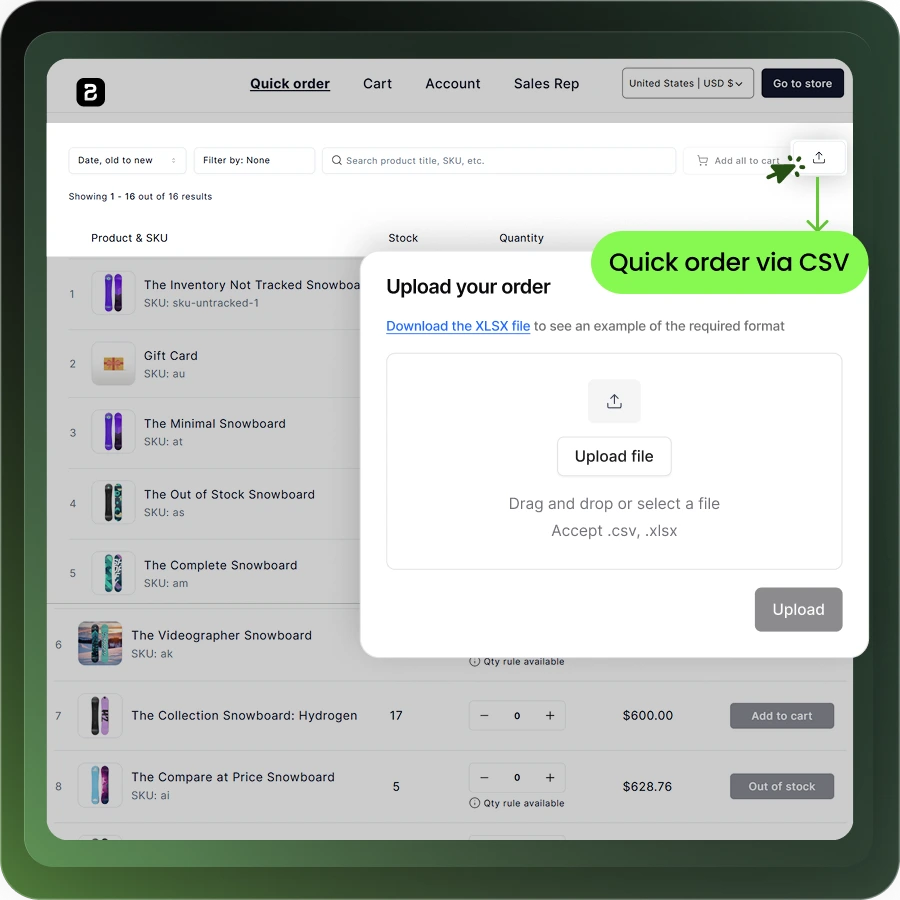
B2B orders are typically larger in both quantity and dollar value. A single wholesale order might include 500 units across 20 variants—which is why bulk ordering tools like quick order forms and CSV upload matter so much for B2B operations.
Pricing Models and Payment Terms
B2B pricing involves tiered discounts, contract price lists, and net payment terms like Net 30 or Net 60. Your buyer expects to see their negotiated price at checkout, not a generic retail price.
Customer Relationships and Contracts
B2B relies on long-term relationships with credit limits and negotiated agreements. You’re managing accounts with specific terms and expectations, not selling to anonymous shoppers.
Technology and Automation Priorities
B2B prioritizes ERP/CRM integration, pricing engines, and quote-to-order workflows. B2C prioritizes fast checkout and personalization. The technology stack reflects these different priorities.
Benefits of Integrating B2B Ecommerce and Supply Chain Management
Real-Time Inventory and Pricing Accuracy
When your ecommerce platform syncs with your ERP, buyers see accurate stock levels and their correct contract price. Outcome: Fewer order errors, fewer disputes, and less time spent on corrections.
Faster Order Processing and Fulfillment
Self-service ordering and automated workflows eliminate manual data entry. Orders move from cart to warehouse faster because no one is re-keying information between systems.
Lower Operational Cost and Fewer Errors
Unified systems reduce duplicate data entry and reconciliation work. Your team spends less time fixing errors and more time on activities that actually grow revenue.
Higher Wholesale Conversion and Buyer Retention
A frictionless B2B buying experience—quick order forms, saved carts, net terms at checkout—increases order frequency. Buyers who can easily reorder become repeat customers.
Better Demand Forecasting From Unified Data
Centralized order data from your ecommerce platform improves forecasting accuracy. You see demand patterns as they happen, not weeks later when someone finally updates the spreadsheet.
Common Challenges in B2B Ecommerce Supply Chain Management
Disconnected ERP, CRM, and Ecommerce Systems
Many B2B teams run separate systems that don’t communicate. The result is data silos, manual reconciliation, and pricing mismatches that frustrate buyers and waste your team’s time.
Limited Supply Chain Visibility
Without real-time data sync, you can’t see inventory levels, order status, or fulfillment bottlenecks across channels. You’re operating partially blind.
Complex Pricing and Contract Management
Managing customer-specific pricing, volume discounts, and contract price lists manually leads to errors. One wrong price on a large order can cost you margin or damage a buyer relationship.
Manual Order Processing and Quote Workflows
When sales reps manually enter orders or process RFQs via email, order cycles slow down and errors multiply. Every manual touchpoint is a potential failure point.
Strategies to Optimize Your B2B Ecommerce Supply Chain
1. Unify B2B and B2C on a Single Storefront
Running one storefront for both channels reduces operational overhead and keeps inventory, pricing, and orders in sync. You don’t need Shopify Plus or a separate B2B site to make this work with the right B2B layer.
2. Sync Pricing, Customers, and Orders With Your ERP
Deep ERP integration—whether NetSuite, Zoho, Odoo, or a custom system—ensures your ecommerce store reflects accurate pricing and inventory without manual updates.
3. Automate Quote-to-Order and Net Terms Workflows
Automating RFQ approval and net payment terms reduces manual work and speeds up large buyer transactions. Your sales team handles exceptions, not routine processing.
4. Enable Self-Service Buyer Portals
Buyers who can log in, view their pricing, place orders, track shipments, and reorder without contacting sales are happier buyers—and they cost you less to serve.
5. Build Real-Time Inventory Visibility Across Channels
Syncing inventory data across your ecommerce platform, ERP, and warehouse prevents overselling and improves fulfillment accuracy.
How to Integrate ERP and CRM With Your B2B Ecommerce Supply Chain
Step 1: Map Your Pricing, Customer, and Order Data Models
Document how pricing, customer groups, and orders are structured in your ERP. Then map how they appear in your ecommerce platform. This groundwork prevents sync errors later.
Step 2: Choose an Integration Method
Three common approaches exist: direct API connections, middleware platforms like Celigo, or native app integrations. Your choice depends on technical resources and complexity.
Step 3: Sync Customer Groups and Contract Price Lists
Connect customer segments and their negotiated prices so buyers see accurate pricing the moment they log in—not a generic price that requires manual correction.
Step 4: Connect Inventory and Order Workflows
Set up bi-directional sync so inventory updates flow to your storefront and orders flow back to your ERP for fulfillment.
Step 5: Test, Monitor, and Scale
Run test orders, monitor sync errors, and build processes to scale as your catalog and customer base grow.
What to Look For in a B2B Ecommerce Platform for Supply Chain Management
Deep ERP and CRM Integration
Look for native connectors or enterprise APIs that sync pricing, customers, and orders with your existing systems without custom development.
Advanced B2B Pricing Engine
The platform supports customer-specific pricing, volume discounts, contract price lists, min/max quantities, and multi-currency—not just simple percentage discounts.
Unified B2B and B2C Storefront
Running both channels on one storefront reduces operational overhead and keeps data consistent across your business.
B2B UX Built for Wholesale Buyers
Features like quick order pages, bulk ordering, saved carts, and net payment terms at checkout match how wholesale buyers actually purchase.
Run B2B Ecommerce Supply Chain Management on Shopify With B2Bridge
B2Bridge embeds enterprise-grade B2B operations directly into Shopify, connecting your ecommerce storefront to your ERP and CRM so pricing, customers, and wholesale orders stay aligned across systems.
- Deep ERP/CRM integration: Sync pricing, customers, and orders with NetSuite, Zoho, Odoo, or custom ERPs
- Advanced B2B pricing engine: Customer-specific pricing, volume rules, contract price lists, multi-currency, tax-exempt logic
- Unified storefront: Run B2B and B2C on one Shopify store without Shopify Plus
- B2B UX for wholesale: Quick order forms, bulk ordering, net terms, quote-to-order workflows

Book A Demo to see how B2Bridge supports B2B ecommerce supply chain management on Shopify.
Frequently Asked Questions About B2B Ecommerce Supply Chain Management
How long does it take to implement B2B ecommerce supply chain management?
Implementation timelines vary based on system complexity and integration requirements. Many merchants launch a functional B2B ecommerce layer in days to weeks with the right partner and platform.
Can you run B2B supply chain operations on standard Shopify without Shopify Plus?
Yes. B2B apps like B2Bridge embed enterprise-grade wholesale operations directly into standard Shopify plans. You don’t need Shopify Plus or a separate B2B site.
How does a B2B pricing engine improve supply chain accuracy?
A B2B pricing engine ensures every buyer sees their negotiated contract price at checkout. This reduces order disputes, manual corrections, and downstream fulfillment errors.
What is the difference between a B2B ecommerce platform and a supply chain management system?
A B2B ecommerce platform is the front-end where buyers place orders. A supply chain management system (typically your ERP) handles back-end operations like inventory, fulfillment, and financials. Integration connects the two.
How does B2B ecommerce supply chain management handle global wholesale?
Effective platforms support multi-currency pricing, regional tax rules, tax-exempt logic, and international shipping workflows—letting you serve global B2B buyers from a single storefront.

As a Product Marketing Executive at B2Bridge, I focus on the Enterprise B2B Ecommerce domain. I leverage my understanding of product and user psychology to deliver customer-centric content that addresses business challenges and fuels growth.