Building a successful B2B Ecommerce strategy requires a customer-centric approach that combines digital convenience with personalized service, such as custom pricing, quick reordering, and advanced search. Key steps include defining target buyer personas, choosing a scalable platform that integrates with ERP/CRM systems, and developing detailed, accurate product catalogs.
This guide synthesizes insights from industry leaders like Shopify, VTEX, and Sana Commerce to walk you through the 7 core pillars, a step-by-step implementation roadmap, key comparisons with B2C approaches, and the 2026 trends you can’t afford to ignore.

Overview of B2B Ecommerce market
The B2B Ecommerce market is projected to hit $36 trillion by 2026, yet most businesses are still leaving serious revenue on the table. Why? Because they treat their digital storefronts as transactional tools rather than loyalty engines. A well-crafted B2B Ecommerce strategy doesn’t just process orders – it builds the kind of long-term relationships that keep buyers coming back, increase customer lifetime value (CLV), and separate market leaders from the rest of the pack.
So, how do you build a B2B Ecommerce strategy that actually drives retention – potentially by 30 to 50%? Whether you’re a wholesaler, distributor, or enterprise seller, you’ll leave with an actionable blueprint.
What Is a B2B Ecommerce Strategy?
A B2B Ecommerce strategy is an integrated plan for optimizing your digital storefront specifically for business buyers. Unlike B2C, which focuses on impulse decisions and one-time transactions, B2B is defined by long sales cycles, high-value repeat orders, complex approval workflows, and deep buyer-seller relationships. Your strategy needs to account for all of that – while making the buying experience as frictionless as possible.
Today, 71% of B2B revenue flows through digital channels. That number is only growing. A modern B2B Ecommerce strategy must go beyond product listings and checkout flows to encompass account-based pricing, bulk reordering, ERP integrations, omnichannel consistency, and data-driven personalization – all working together to maximize CLV and minimize churn.
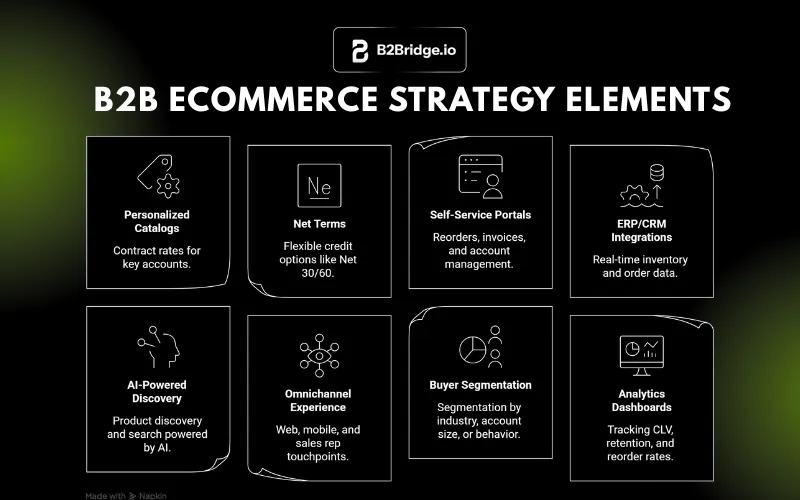
The 8 essential elements of a strong B2B Ecommerce strategy include:
- Personalized catalogs and account-based pricing (e.g., contract rates for key accounts)
- Net terms and flexible credit options (e.g., Net 30/60 via TreviPay or similar)
- Self-service portals for reorders, invoices, and account management
- ERP and CRM integrations for real-time inventory and order data
- AI-powered product discovery and search
- Omnichannel experience across web, mobile, and sales rep touchpoints
- Buyer segmentation by industry, account size, or purchase behavior
- Analytics dashboards to track CLV, retention, and reorder rates
Together, these elements form the foundation for the 7 loyalty pillars we’ll explore next.
7 Pillars of a Successful B2B Ecommerce Strategy
“Understanding the current state of B2B eCommerce helps contextualize why certain strategies matter more than others. 73% of B2B buyers now expect to research and compare options online before engaging with sales teams. 78% of B2B decision-makers say their purchase experience is as important as product quality.” (Scaling B2B eCommerce Success on Shopify: A Playbook for 2026 by B2Bridge.io)
Here are 7 successful pillars B2B Ecommerce strategy you shouldn’t miss.
Pillar 1: Buyer Segmentation and Personalization
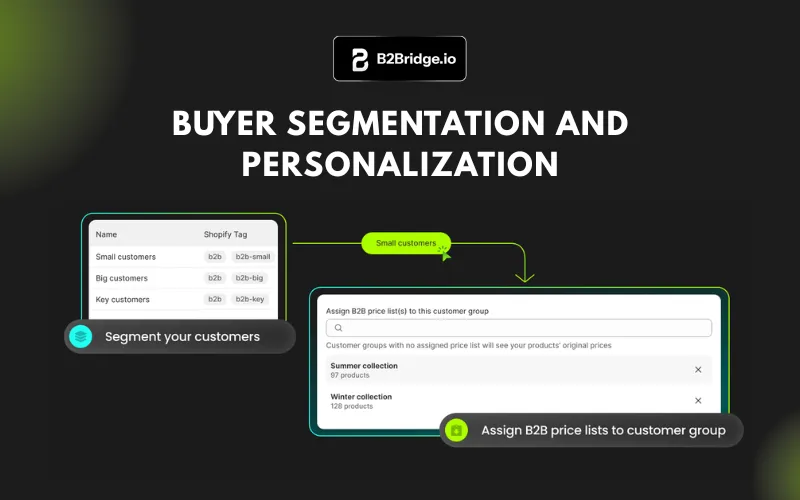
Personalization is no longer a nice-to-have – it’s the price of admission in B2B Ecommerce. When buyers see pricing, catalogs, and recommendations tailored to their account, they feel understood. That sense of relevance is a core driver of loyalty: research shows personalized experiences increase repeat purchases by up to 40%.
In 2026, AI-powered segmentation goes beyond firmographics. It analyzes purchase history, browsing behavior, and reorder cadence to deliver hyper-personalized recommendations and dynamic pricing tiers. Platforms like Shopify Plus and B2Bridge enable role-based portals where a procurement manager sees something entirely different from a shop floor buyer – reducing friction and accelerating decisions.
Pillar 2: Frictionless Self-Service Portals
Your buyers don’t want to call a sales rep to check an order status or resubmit a recurring purchase. Self-service portals solve this – and the data backs it up. Companies that deploy robust self-service dashboards report up to a 60% reduction in inbound support requests and a measurable jump in buyer satisfaction scores.
A good self-service portal lets buyers reorder with one click, view invoices, manage multiple shipping addresses, track shipments, and access account history – all without human intervention. Shopify Plus case studies consistently show that self-service portals reduce churn by making the buying relationship sticky, convenient, and scalable.
Pillar 3: Omnichannel Seamless Experience
Today’s B2B buyer researches on mobile, approves on desktop, and may complete the purchase through a sales rep’s assisted checkout. Mobile now drives over 50% of B2B web traffic, meaning a poor mobile experience directly costs you deals. An omnichannel B2B Ecommerce strategy ensures every touchpoint – web portal, mobile app, EDI, and direct sales – delivers a consistent, connected experience.
Brands that nail omnichannel consistency see Net Promoter Scores (NPS) improve by up to 25%, because buyers trust that pricing, inventory, and order history are always accurate, no matter the channel they’re using. Unified commerce platforms like VTEX are purpose-built for this kind of cross-channel coherence.
Pillar 4: Flexible Payment and Credit Options
Cash flow is the lifeblood of any B2B buyer. When you offer Net 30 or Net 60 terms, you’re not just making it easier to buy – you’re embedding your business into your customer’s financial workflow. According to TreviPay research, B2B sellers offering flexible trade credit close deals at nearly twice the rate of those that don’t.
Beyond net terms, consider offering ACH, virtual cards, purchase orders, and installment options. Each payment flexibility you add removes a potential reason for a buyer to look elsewhere. Over time, buyers who use your credit terms develop a dependency that drives loyalty – and a higher LTV.
Pillar 5: Robust ERP and CRM Integrations
Nothing destroys buyer trust faster than a wrong price, an out-of-stock surprise, or a delayed order that wasn’t flagged in advance. ERP and CRM integrations eliminate these errors by syncing inventory, pricing, and customer data in real time between your Ecommerce platform and back-office systems.
Businesses that implement bi-directional ERP integrations report up to a 35% reduction in order errors and a significant improvement in delivery reliability – two factors that directly correlate with higher retention rates. Platforms with native ERP connectors (SAP, NetSuite, Microsoft Dynamics) give you a competitive edge by enabling trusted, scalable operations.
Pillar 6: Advanced Product Discovery Tools
In B2B, buyers often know exactly what they need – but finding it in a catalog of thousands of SKUs can be a painful process. AI-powered search, faceted filtering, and Bill of Materials (BOM) upload tools can cut procurement time by up to 50%, turning a frustrating one-off experience into a streamlined, repeatable process.
When buyers can find, configure, and reorder products quickly, they’re far more likely to make your platform their default procurement channel. Advanced discovery tools – including natural language search and guided selling – are becoming standard in leading B2B platforms for exactly this reason.
Pillar 7: Data-Driven Optimization Loops
The best B2B Ecommerce strategies aren’t built once – they’re continuously refined. CLV analytics, cohort analysis, funnel tracking, and A/B testing give you the insight to identify where buyers drop off, which segments are most loyal, and what interventions drive repeat purchases.
Businesses that build systematic optimization loops into their Ecommerce operations report 30% loyalty uplift over 12 to 18 months. Tools like Google Analytics 4, ERP dashboards, and platform-native analytics (Shopify Analytics, VTEX’s data layer) provide the raw material – but the real advantage comes from building a culture of continuous improvement around that data.
Step-by-Step Guide to Building Your B2B Ecommerce Strategy
From initial audit to full-scale optimization, this 10-phase roadmap gives you a clear execution path for building a loyalty-driven B2B Ecommerce strategy. Each step is designed to build on the last – so don’t skip ahead.
Step 1: Conduct a Buyer Journey Audit
Start by mapping your current buyer journey from awareness to reorder. Identify friction points – manual quoting, phone-only ordering, limited payment options – and compare them to what your top 20% of accounts actually need. Survey at least 20% of high-value customers directly. The gaps you find here will shape your entire strategy.
- Document every buyer touchpoint (web, rep, EDI, phone)
- Identify the top 5 friction points causing drop-off or churn
- Interview or survey key accounts about self-service needs
- Benchmark current retention and reorder rates
Step 2: Define Loyalty-Focused KPIs
Before building anything, establish baselines and set clear targets. Without defined KPIs, you can’t measure whether your B2B Ecommerce strategy is actually driving loyalty.
- Customer retention rate: Target 60%+ (best-in-class: 85%)
- Customer lifetime value: Set account-tier benchmarks (e.g., $50K+ for enterprise)
- Reorder rate and average order frequency
- Self-service adoption rate and support ticket volume
Step 3: Select Your Platform and Tech Stack
Platform selection is one of the highest-leverage decisions you’ll make. Evaluate B2B-native platforms like Shopify Plus, BigCommerce B2B Edition, or B2Bridge against your requirements: net terms support, ERP connectors, account-based pricing, and self-service capabilities. Prioritize platforms with native B2B features over those that require heavy customization.
Step 4: Design Personalized Experiences
Build buyer portals with tiered access, custom catalogs, and role-based pricing. Use A/B testing to optimize UI layouts, call-to-action placement, and product recommendation modules. Start with your top 3 account segments and expand from there.
Steps 5–10: Integrate, Launch, and Iterate
The remaining phases cover payment and ERP integration (Step 5), MVP launch with a pilot cohort (Step 6), demand generation and account-based marketing activation (Step 7), and three cycles of measurement, optimization, and scale (Steps 8-10). Each phase should be tied to the KPIs defined in Step 2, with monthly review cadences to course-correct quickly.
B2B vs. B2C Ecommerce Strategy: Key Differences
Understanding how B2B differs from B2C is essential for avoiding the most common strategic mistake: applying consumer Ecommerce logic to business buyers. Here’s a clear comparison:
| Aspect | B2B Approach | B2C Approach | Loyalty Impact |
|---|---|---|---|
| Pricing | Dynamic, account-based tiers | Fixed, universal pricing | +35% repeat purchases via contract pricing |
| Buying Cycle | Long (weeks to months) | Short (minutes to days) | Relationship depth drives LTV |
| Order Size | High-volume, recurring | Low-volume, variable | Reorder automation increases frequency |
| Payment Terms | Net 30/60, PO, ACH | Credit card, PayPal | 2x deal close rate with net terms |
| Decision Makers | Multiple stakeholders | Individual consumer | Role-based portals reduce friction |
| Self-Service | Critical (60% support reduction) | Expected baseline | Empowerment drives NPS +25% |
| Catalog | Custom by account/segment | Universal storefront | Personalization boosts repeats +40% |
| Search & Discovery | BOM upload, PN search | Keyword/browse | 50% faster procurement = loyalty |
| Analytics | CLV, cohort, account health | Conversion, AOV | Optimization loops = +30% retention |
| Integration Needs | ERP, CRM, EDI critical | PMS, CRM optional | Real-time sync eliminates trust-breakers |
2026 Trends Transforming B2B Loyalty Strategies
The B2B Ecommerce landscape is shifting fast. Here are eight trends reshaping how companies build and sustain buyer loyalty:
- AI Purchasing Agents: Autonomous AI buyers will place and manage orders on behalf of procurement teams – your platform needs machine-readable catalogs and API-first architecture to participate. Early adopters report 25% higher retention from AI-assisted reordering.
- Composable Commerce: Modular tech stacks (headless CMS, API-based checkout, independent loyalty modules) allow faster iteration and personalization at scale – critical for serving diverse buyer segments.
- B2B Subscriptions and Auto-Replenishment: Subscription models for consumables and MRO supplies are growing 30% YoY. Buyers who subscribe churn at half the rate of one-time purchasers.
- Embedded Finance: Buy Now Pay Later (BNPL) for B2B and embedded net terms at checkout are becoming table stakes, reducing payment friction and accelerating deal cycles.
- Predictive Reorder Alerts: AI-driven replenishment nudges (“You typically reorder this item every 45 days – stock is running low”) improve reorder rates by up to 25%.
- Sustainability Dashboards: Enterprise buyers increasingly require carbon footprint data and ESG reporting at the SKU level – adding this drives retention among compliance-driven accounts.
- Video Commerce and Guided Selling: Product explainer videos, virtual demos, and AI-guided configurators are reducing returns and increasing buyer confidence in complex product categories.
- Unified B2B/B2C Platforms: Companies serving both segments are consolidating onto platforms like Shopify Plus or VTEX that handle both models without separate systems – streamlining ops and enabling cross-sell opportunities.
B2B Ecommerce Strategy: Financial Statistics and Benchmarks
How does your performance stack up? Here are the key benchmarks from leading B2B Ecommerce analyses:
| Metric | Average Performer | Top Quartile | Driver |
|---|---|---|---|
| Customer Retention Rate | 65% | 85% | Self-service portals + personalization |
| CLV Growth (Year 1 vs. Year 3) | 1.5x | 3x | Account-based pricing + net terms |
| Reorder Rate | 42% | 68% | One-click reorder + predictive alerts |
| Support Ticket Reduction | 25% | 60% | Self-service adoption |
| Conversion Rate (B2B) | 2.5% | 5.2% | AI search + frictionless checkout |
| Mobile Commerce Share | 35% | 52% | Mobile-optimized portals |
Real-World Case Studies: B2B Ecommerce Loyalty Wins
Case Study 1: Industrial Distributor Cuts Churn by 40%
A mid-size industrial distributor was losing accounts to competitors with better online ordering experiences. After implementing a self-service portal with one-click reordering, account-based pricing, and ERP integration, they reduced churn by 40% within 12 months. Key to their success: proactively migrating their top 100 accounts to the new portal with dedicated onboarding support, which drove 85% adoption in the first 90 days.
Case Study 2: Wholesale Food Supplier Doubles Reorder Frequency
A regional food wholesaler deployed AI-powered predictive reorder alerts alongside a Net 30 payment option. Within six months, average order frequency among enrolled accounts doubled, and average order value increased by 18% as buyers added complementary items surfaced by the AI recommendation engine. The combination of payment flexibility and smart discovery turned occasional buyers into loyal, high-frequency accounts.
Frequently Asked Questions About B2B Ecommerce Strategy
Net terms embed your business into a buyer’s financial workflow. When a company relies on your Net 30 terms to manage cash flow, switching to a competitor becomes costly and complex – not just operationally, but financially. Data shows buyers using trade credit terms have 2x the LTV of those paying by credit card, and churn at significantly lower rates.
Most B2B businesses see measurable ROI from AI personalization within 6 months, with full payback typically achieved within 12 months. The primary gains come from increased reorder rates (driven by relevant product recommendations) and reduced support costs (driven by smarter self-service). Enterprises with larger account bases and more complex catalogs tend to see faster ROI.
Yes – an MVP-first approach is recommended. Start with a B2B-native platform that handles account-based pricing and self-service reordering, and use manual or CSV-based inventory syncs in the early stages. Plan ERP integration for Phase 2 once your platform is live and generating reliable order data. Waiting for a perfect integration before launching will cost you more in lost loyalty than the temporary operational overhead.
Based on aggregated data from Shopify, VTEX, and Sana Commerce, the single highest-impact change is deploying a self-service reordering portal for your top accounts. This one change can reduce churn by 20 to 30% within 6 months by making your platform the path of least resistance for repeat purchases.
Conclusion
A successful B2B Ecommerce strategy is not about having the flashiest storefront. It’s about making it easier, smarter, and more reliable for your buyers to do business with you – every single time. By implementing the 7 pillars outlined here – from personalization and self-service to data-driven optimization – you build the kind of frictionless experience that turns first-time buyers into long-term accounts.
| Don’t build your B2B Ecommerce strategy alone, build with B2Bridge – a platform purpose-built for B2B growth. Schedule your free consultation today and see what a loyalty-first approach looks like in action. |

Hi, I’m Hanh – a product marketing professional passionate about driving growth, simplifying complex solutions, and creating impactful strategies for Shopify that connect products with customers.