The four primary types of B2B (Business-to-Business) markets – based on the buyer’s role – are Producers, Resellers, Governments, and Institutions. Each group has distinct purchasing needs, ranging from raw materials for production to goods for resale or mission-driven and public sector procurement.
In this comprehensive guide, we’ll explore the main B2B Ecommerce business models – from traditional wholesale and manufacturing to government sales (B2G), supply chain models (B2B2B), and specialized platforms like SaaS and marketplaces. We’ll examine the critical differences between B2B and B2C operations and provide practical insights for implementing these models on Shopify.

B2B Ecommerce Fundamentals
Before diving into the specific types of B2B Ecommerce, it’s essential to understand what distinguishes B2B transactions from consumer-facing commerce. B2B Ecommerce is characterized by several core features that make it uniquely complex: multiple stakeholders involved in purchase decisions, variable pricing based on customer relationships and order volumes, significantly larger order quantities, and ongoing relationships that span years rather than one-time transactions.
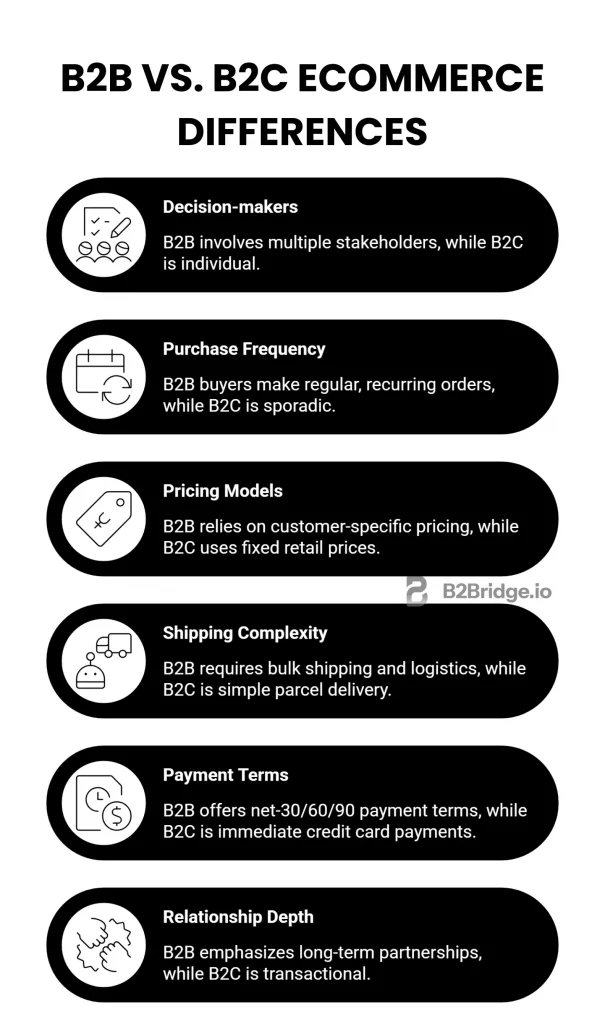
The fundamental differences between B2B and B2C Ecommerce shape every aspect of your digital strategy:
- Decision-makers: B2B involves multiple stakeholders and approval chains, while B2C features individual purchase decisions
- Purchase frequency: B2B buyers make regular, recurring orders on negotiated terms versus sporadic B2C consumer purchases
- Pricing models: B2B relies on customer-specific pricing, volume discounts, and contract rates rather than fixed retail prices
- Shipping complexity: B2B requires bulk shipping, delivery scheduling, and freight logistics compared to simple parcel delivery
- Payment terms: B2B offers net-30/60/90 payment terms and purchase orders instead of immediate credit card payments
- Relationship depth: B2B emphasizes long-term partnerships and account management versus transactional customer interactions
These distinctions matter because they directly influence which B2B Ecommerce business model best describes your business and what features your digital platform needs to succeed. A wholesale distributor carrying multiple brands has different needs than a manufacturer selling their own products exclusively. For Shopify merchants building B2B capabilities, understanding where you fit among the various B2B Ecommerce business models helps in selecting the right apps, configuring appropriate workflows, and creating customer experiences that match buyer expectations.
Types of B2B Ecommerce Business Models
B2B Wholesale Distributor
The B2B wholesale distributor model represents one of the most established B2B Ecommerce business models, where companies purchase products in bulk from multiple manufacturers and resell them to retailers, dealers, or other businesses. Distributors act as intermediaries in the supply chain, aggregating products from various suppliers and providing convenient one-stop shopping for buyers who need products from multiple brands.
This B2B Ecommerce business model thrives on breadth of selection, logistics efficiency, and the ability to consolidate ordering and shipping for customers who would otherwise need to manage relationships with dozens of individual manufacturers.
For Ecommerce implementation, wholesale distributors face unique challenges. They need systems that can manage thousands of SKUs from multiple manufacturers, each potentially with different pricing structures, availability rules, and shipping requirements.
“A B2B eCommerce marketplace helps manufacturers and distributors reach more buyers, simplify operations, and grow digitally.
Instead of relying only on traditional channels, businesses can showcase products online, manage bulk orders, and connect with verified partners across regions.” – Yuvaraj S
B2B Manufacturer
The B2B manufacturer model is one of the fastest-growing B2B Ecommerce business models, involving companies that produce their own products and sell directly to retailers, dealers, distributors, or other businesses without intermediaries. This direct-to-business approach gives manufacturers greater control over pricing, brand presentation, customer relationships, and market intelligence.
Manufacturers pursuing direct B2B Ecommerce are following the success of companies like Cisco, which achieved over $1 billion in annual sales through its direct online marketplace, Cisco Connection Online.
By creating sophisticated Ecommerce platforms, manufacturers can offer real-time product configuration, immediate pricing, technical documentation, and order tracking – all within a branded experience that strengthens their market position. This approach works especially well for manufacturers with strong brand recognition, complex or configurable products, and customers who value direct access to the source.
The strategic advantages for manufacturers selling direct are substantial. They maintain complete control over product positioning, pricing strategy, and customer experience without compromise.
However, the manufacturer-direct model also presents challenges. Manufacturers must invest in Ecommerce technology, customer service infrastructure, and fulfillment operations that distributors traditionally handled. They risk channel conflict if they sell directly while also working with distributors or dealers who view the manufacturer as competition.
B2B vs B2C Ecommerce
Understanding the differences between B2B and B2C Ecommerce business models is crucial because many businesses operate hybrid models, selling both to businesses and consumers through different channels. The distinction goes far beyond just who the customer is – it encompasses different purchasing behaviors, technology requirements, marketing approaches, and operational workflows. Businesses that successfully manage both B2B and B2C channels recognize that each requires dedicated strategies, even when operating on the same underlying platform.
“While DTC shaped how we think about ecommerce, B2B is where the real scale exists. Buyers now expect the same self-serve, fast, and intuitive experience they get in personal shopping. They want to research, place orders, manage pricing, and track fulfillment digitally, without relying on emails, calls, or manual processes.” – Santhosh Kumar (Lead Software Engineer for Ecommerce company)
The purchasing process differs fundamentally between B2B and B2C. Consumer purchases are typically impulse-driven or need-based, completed in a single session by one person making a quick decision.
B2B purchases involve research, comparison, internal discussion, approval processes, and negotiation that can span days, weeks, or months. A consumer might spend five minutes buying a product online; a business buyer might spend five weeks evaluating suppliers, requesting quotes, and securing budget approval before placing an order.
Pricing and payment structures create another major distinction. B2C Ecommerce relies on transparent, fixed pricing with occasional promotional discounts that apply to all customers equally. Payment happens immediately via credit card or digital wallet.
B2B Ecommerce involves complex, relationship-based pricing where different customers pay different prices based on volume commitments, contract terms, or negotiated agreements. Payment typically occurs on credit terms – net-30, net-60, or net-90 – with purchase orders rather than immediate transactions.
Wholesale Business Models
The traditional wholesale business model encompasses companies whose primary or exclusive focus is selling products in bulk quantities to other businesses rather than to end consumers.
This broad category includes both distributors carrying multiple brands and manufacturers selling their own products, but unified by their focus on business-to-business transactions at wholesale price points. Among all B2B Ecommerce business models, wholesale operations succeed by providing value through bulk pricing, reliable supply, convenient ordering, and often additional services like merchandising support, training, or co-marketing assistance.
Wholesale businesses are experiencing dramatic transformation through digital commerce. Industry data shows that companies implementing dedicated B2B Ecommerce portals on platforms like Shopify have seen their wholesale channels grow to represent 75% or more of total revenue, demonstrating how effectively digital tools can expand and accelerate B2B sales.
These businesses succeed by bringing consumer-grade digital experiences to business buyers, offering 24/7 self-service ordering, mobile accessibility, and streamlined reordering that reduces friction in the purchasing process.
B2G (Business-to-Government) Ecommerce
The B2G ecommerce business model represents sales from businesses to government agencies, municipalities, educational institutions, and other public-sector organizations.
This specialized B2B ecommerce business model operates under unique rules, requiring businesses to navigate complex procurement regulations, compliance requirements, and competitive bidding processes. Government buyers follow strict purchasing protocols, often requiring vendors to register on official portals, obtain certifications, and submit detailed proposals before winning contracts.
The opportunities in B2G ecommerce are substantial. The US federal government alone spends over $600 billion annually on goods and services, with state and local governments adding hundreds of billions more.
B2B2B (Supply Chain Integration) Model
The B2B2B ecommerce business model represents multi-tier supply chain relationships where businesses sell to other businesses, who then sell to additional businesses before products reach end users.
This model is common in industries with complex distribution networks – manufacturers sell to regional distributors (first B2B), who sell to local dealers or retailers (second B2B), who finally sell to consumers or business end-users. The defining characteristic is the extended supply chain where multiple business transactions occur before final delivery.
B2B2B models create value through specialization at each tier. Manufacturers focus on production efficiency and product innovation. Regional distributors provide warehousing, logistics, and territory coverage.
Local dealers offer customer relationships, technical support, and market knowledge. Each tier adds specific value while passing products and information through the chain. Modern B2B2B strategies emphasize supply chain visibility, where upstream suppliers can see downstream demand patterns and inventory levels to optimize production and distribution.
B2B SaaS (Software-as-a-Service) Model
The B2B SaaS ecommerce business model represents one of the fastest-growing segments, where software companies provide cloud-based applications to business customers through subscription models. Unlike traditional software sales involving one-time licenses, SaaS operates on recurring revenue where customers pay monthly or annual fees for continued access.
This model has revolutionized how businesses buy software by eliminating large upfront costs, reducing implementation complexity, and providing continuous updates and improvements.
B2B SaaS companies succeed through predictable recurring revenue, high gross margins (often 70-90% once developed), and compounding growth as they retain customers while adding new ones.
The economics are fundamentally different from product-based B2B models. Success metrics focus on Monthly Recurring Revenue (MRR), Customer Acquisition Cost (CAC), Lifetime Value (LTV), and churn rate rather than order volume and margins. A SaaS company might lose money acquiring customers but become highly profitable as those customers pay subscriptions for years.
B2B Marketplace Model
The B2B marketplace ecommerce business model creates platforms where multiple sellers offer products or services to business buyers, with the marketplace operator facilitating transactions, providing search and discovery tools, and typically taking a commission or subscription fee.
This model differs from single-seller stores by aggregating supply from many vendors, creating network effects where more buyers attract more sellers and vice versa. Alibaba’s B2B platform, processing over $170 billion annually, exemplifies this model at massive scale.
Successful B2B marketplaces typically specialize in specific industries or product categories rather than attempting to serve all B2B needs.
The marketplace business model offers attractive economics with high margins (20-30% commissions are common), capital efficiency since the marketplace doesn’t hold inventory, and scalability as revenue grows with transaction volume rather than physical operations.
B2B Ecommerce Trends 2026
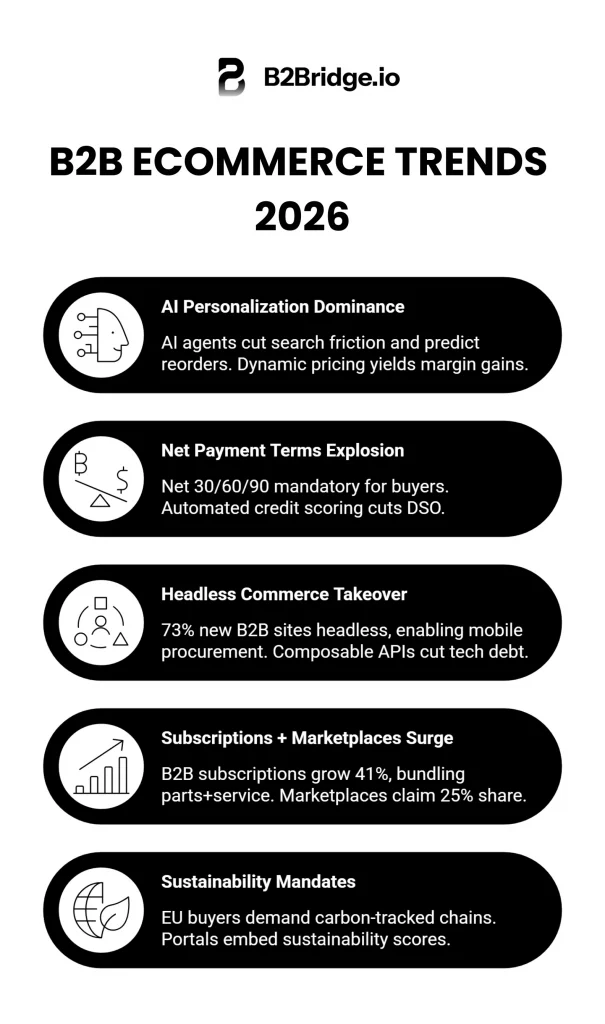
B2B ecommerce hits $36 trillion globally by 2026 (14.5% CAGR), with manufacturing/healthcare/energy sectors leading digital adoption. Millennials/Gen Z (71% of buyers) demand B2C speed through AI, flexible payments, and self-service.
AI Personalization Dominance
AI agents cut search friction 50%, predicting reorders with 87% accuracy across 10K+ SKUs. Dynamic market-based pricing yields 15-20% margin gains by analyzing competitor moves and buyer patterns. Shopify wholesalers use AI upselling for 10-20% AOV lift; voice reordering (“restock forklift parts”) standard.
Net Payment Terms Explosion
Net 30/60/90 mandatory – 68% buyers require flexibility. Automated credit scoring cuts DSO 22 days. Faire proves net 60 converts browsers to loyalists. B2Bridge edge: Native Net 30/60/90 implementation sees 68% buyer adoption.
Headless Commerce Takeover
73% new B2B sites headless, enabling mobile procurement and marketplace sync. Composable pricing/payment APIs cut tech debt 40%. Shopify’s B2Bridge APIs support multi-model flexibility – direct portals + subscriptions + marketplaces in one stack.
Subscriptions + Marketplaces Surge
B2B subscriptions grow 41%, bundling parts+service for predictable revenue. Marketplaces claim 25% share. Shopify play: B2Bridge powers hybrid models – subscription tiers for retention, marketplaces for acquisition. LTV jumps 27% for subscription-first wholesalers.
Sustainability Mandates
EU buyers demand carbon-tracked chains (62% factor ESG). Portals embed sustainability scores + social proof (32% conversion lift). B2Bridge: Displays verified reviews per pricing tier, wins government contracts.
Key takeaway: Winners integrate all 5 trends. B2Bridge delivers a complete stack – AI pricing, Net 60, headless-ready – future-proofing any B2B model.
Types of B2B Ecommerce: Case Studies
Multi-Brand Distributor Success: 70% Digital Order Volume
A mid-sized wholesale distributor carrying plumbing and HVAC supplies from 50+ manufacturers implemented a comprehensive B2B Ecommerce platform to serve contractors and dealers. By creating a searchable catalog of 15,000 SKUs with detailed specifications, cross-reference tools, and customer-specific pricing, they achieved 70% of order volume through digital self-service within 18 months.
Order processing costs dropped 45%, while average order size increased 22% due to improved product discovery. The platform integrated with supplier feeds for real-time inventory and automated reorder processes, eliminating stockouts and overselling issues.
Manufacturer Direct Model: $1B+ Annual Sales
Cisco’s transformation to direct B2B Ecommerce through Cisco Connection Online demonstrates the power of manufacturer-direct models at scale. By offering real-time product configuration, immediate pricing, technical documentation, and order tracking through a self-service portal, Cisco exceeded $1 billion in annual online sales.
The platform reduced order processing costs by over 40% while improving customer satisfaction through 24/7 access and faster fulfillment. Key success factors included seamless integration with back-end systems, personalized experiences for different customer segments, and comprehensive product information that reduced the need for sales support.
Hybrid B2B/B2C Brand: 75% Revenue from Wholesale
A consumer packaged goods brand successfully operates both retail and wholesale channels through Shopify, with B2B now representing 75% of total revenue. They maintain separate storefronts – a consumer-facing site with storytelling and retail pricing, and a password-protected wholesale portal with bulk ordering tools and tiered pricing for retailers.
The wholesale portal features quick order forms, automated reorder reminders based on each retailer’s sales velocity, and integrated inventory that shows real-time availability. This dual-channel approach captures both direct-to-consumer margins and high-volume wholesale relationships without channel conflict.
FAQs about B2B Ecommerce Types
The B2B ecommerce model involves businesses selling products or services to other businesses online, typically using contract pricing, bulk orders, account-based portals, and long-term buyer–seller relationships.
The seven ecommerce models are B2B, B2C, C2C, C2B, B2G, D2C, and B2B2C, covering transactions between businesses, consumers, and governments across digital marketplaces and direct online channels.
B2B ecommerce includes manufacturer-to-business, wholesaler-to-retailer, distributor-to-business, and B2B marketplaces, enabling bulk ordering, negotiated pricing, and long-term supply relationships across digital platforms.
The four main B2B types are producers selling to retailers, wholesalers selling to retailers, manufacturers selling to distributors, and service providers selling to businesses, all focused on high-volume, repeat business transactions.
Wholesale distributors purchase products from multiple manufacturers and resell them to businesses, acting as intermediaries who provide selection breadth and convenience. They carry many brands and focus on logistics, inventory management, and consolidated ordering. Manufacturers sell their own products directly to businesses, maintaining control over brand presentation, pricing, and customer relationships. Distributors excel at offering one-stop shopping across many brands; manufacturers excel at deep product expertise and direct customer support.
Yes, and many successful merchants do, but it requires careful configuration. The best approach is creating separate customer experiences using Shopify’s B2B features or dedicated apps like B2Bridge. Hide wholesale pricing from public visitors and show it only to approved business accounts. Use different discount structures for retail promotions versus wholesale pricing.
Most small businesses start with a direct wholesale model, selling their own products to retailers or other businesses through a dedicated Shopify portal. This approach requires less complexity than becoming a multi-brand distributor and allows you to maintain control over brand presentation and customer relationships. As you grow, you might expand into hybrid models – perhaps carrying complementary products from other manufacturers or creating tiered channels where you sell some products direct and others through distribution partners.
Payment terms vary by business type and customer relationship. Wholesale distributors typically offer net-30 terms to established customers with good credit, while requiring prepayment from new accounts. Manufacturers often provide more flexible terms to large direct accounts (net-60 or net-90) while offering standard terms to smaller buyers. The key is implementing credit approval processes, setting customer-specific payment terms in your Ecommerce platform, and integrating with accounting systems to manage accounts receivable effectively.
B2Bridge – A B2B Shopify app: Implement any model seamlessly
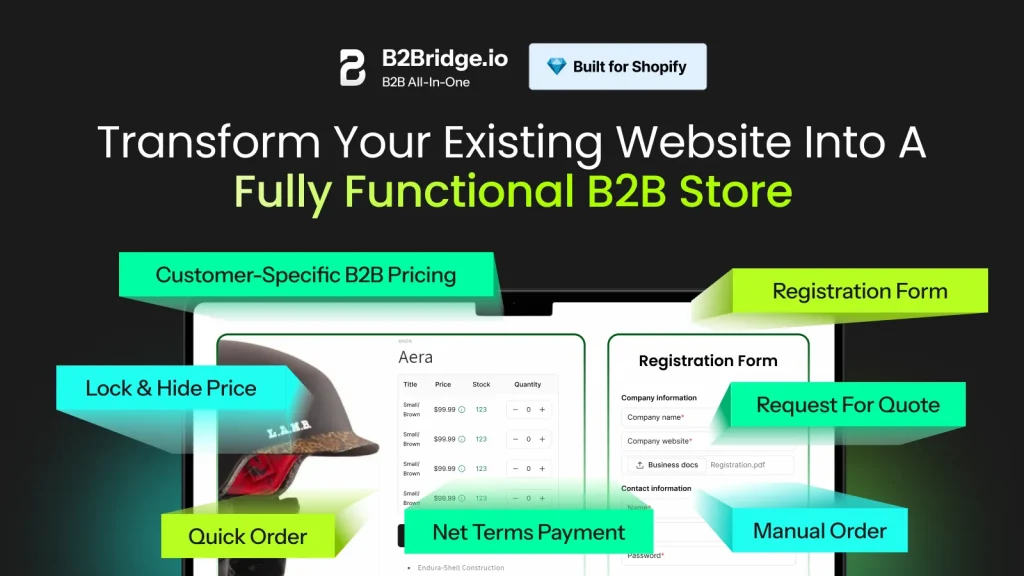
Regardless of which type of B2B Ecommerce describes your business – wholesale distributor, manufacturer, hybrid B2B/B2C, or traditional wholesaler – you need the right tools to implement it effectively. That’s where B2Bridge comes in:
- Simplify wholesale management: Run B2B as easily as B2C with B2Bridge’s all-in-one wholesale tools that handle everything from customer approval to custom pricing without technical complexity.
- Protect your pricing: Hide wholesale prices from retail shoppers and show the right price to the right customer automatically, maintaining clear separation between B2B and B2C channels.
- Scale with confidence: Grow your B2B channel without messy spreadsheets or manual work – B2Bridge automates the operational heavy lifting as your wholesale business expands.
- Save time on operations: Automate registration, price lists, and order handling so you can focus on building relationships and growing revenue rather than administrative tasks.
- Offer a seamless buyer experience: Give your B2B buyers a smooth, self-serve shopping journey that matches the convenience they expect from consumer Ecommerce.
- Close more wholesale deals: Turn requests for quotes into orders with built-in negotiation tools that streamline the quote-to-order process.
- Future-proof your store: B2Bridge adapts as your wholesale grows – no need for multiple apps or costly redevelopment as your needs evolve.
Conclusion
Understanding the four types of B2B Ecommerce – wholesale distributors, manufacturers selling direct, B2B vs B2C operations, and traditional wholesale business models – is essential for building a successful digital commerce strategy.
For Shopify merchants, success in B2B Ecommerce starts with clearly identifying which type of B2B business you operate, understanding the specific requirements of that model, and implementing the right tools to support your operational needs and growth objectives. With apps like B2Bridge that add sophisticated B2B functionality without technical complexity, businesses of any size can compete with enterprise-level B2B experiences and capture the growth opportunity that digital wholesale commerce represents.

Hi, I’m Hanh – a product marketing professional passionate about driving growth, simplifying complex solutions, and creating impactful strategies for Shopify that connect products with customers.